Space Distance & Scale Tools
Explore 5 fascinating articles about space distance & scale tools
Visualize cosmic scales and measure interstellar distances. Explore the vast dimensions of the universe with scale calculators.
All Articles (5)
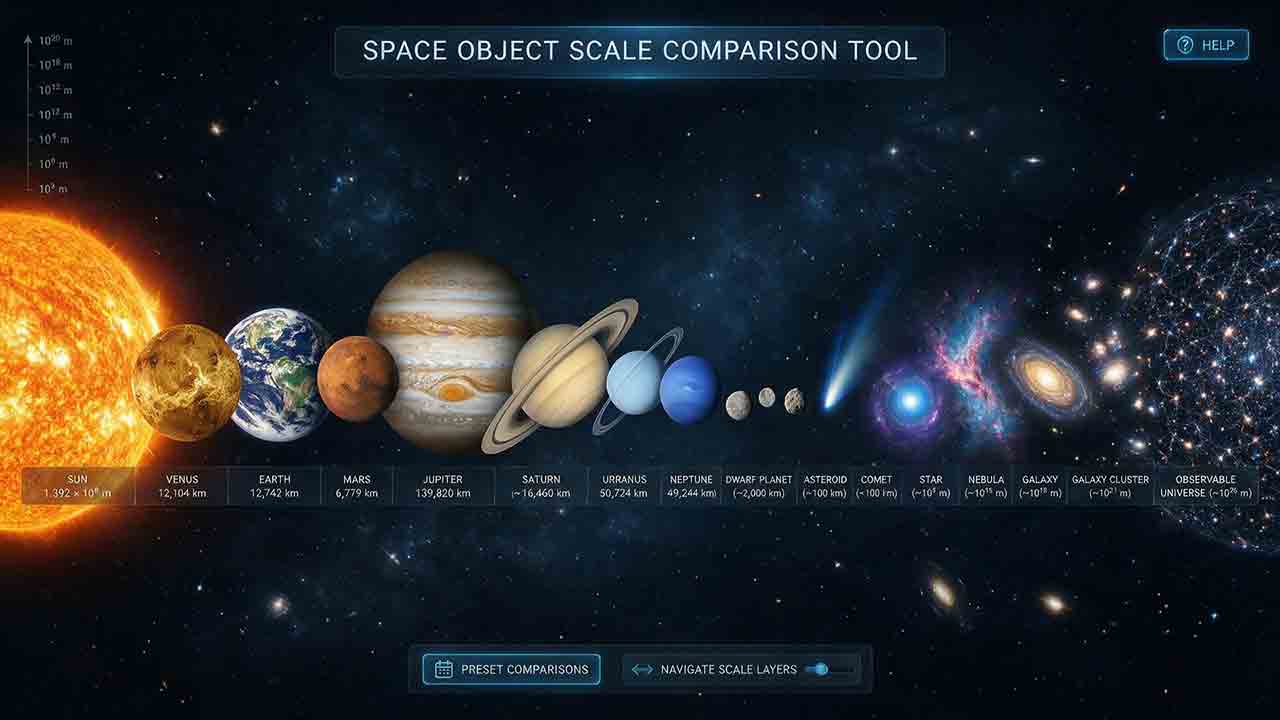
Space Object Scale Comparison Tool
This guide explains how to compare the physical sizes of Bennu, Ceres, Pluto, the Moon, the eight planets, and the Sun on one consistent linear scale. It defines the verified preset objects, distinguishes mean diameter from nominal or approximate width, and shows how to calculate diameter ratios, reference percentages, and scaled model sizes. Original value comes from the Definition–Ratio–Resolution Framework, the Scale-Span Problem, reversible ratio checks, and clear labels for reference-circle area and reference-sphere volume derivations. Worked examples include an Earth-at-10-centimeters model and the visibility limits created by the Sun-to-Bennu size span. The article also explains why rings, comet comae, exoplanets, diffuse nebulae, and black-hole boundaries require custom definitions rather than ordinary planet-diameter presets. Readers gain a practical method for building accurate classroom models, tables, and visualizations without mixing physical size, mass, orbital distance, or angular size.
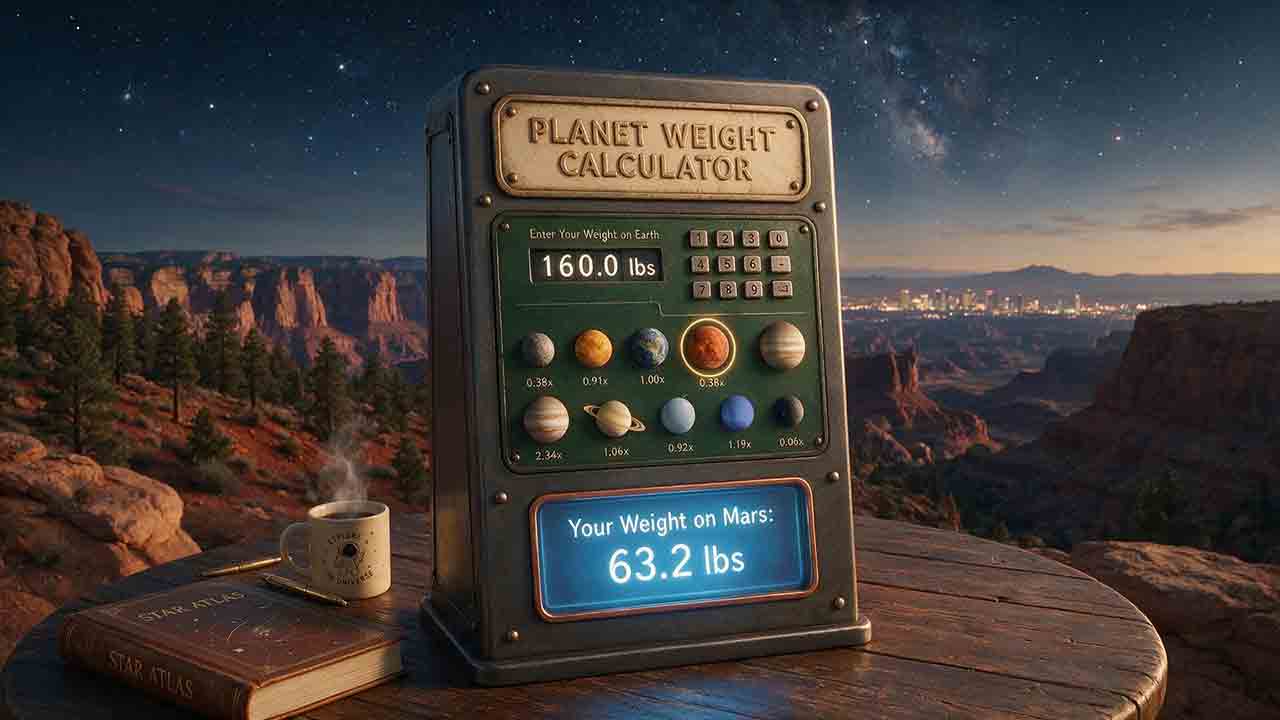
Planet Weight Calculator
This guide explains how a planet weight calculator separates unchanged mass from gravitational force and standard-Earth force equivalents. It shows how to calculate weight with W = mg, interpret kilograms, pound-mass, newtons, pound-force, kg-equivalent, and lb-equivalent, and understand why local scale readings depend on instrument calibration. Sourced gravity presets cover the eight planets, the Moon, and Pluto, with clear warnings for giant planets that have no solid surface. Worked examples, verification values, altitude limits, custom-planet formulas, uncertainty propagation, and the original Reference–Instrument–Support Check help readers evaluate results without confusing force, mass, apparent weight, or reference gravity. The article also explains free fall, reference radii, Pluto data differences, and when a body-specific gravity model is required.
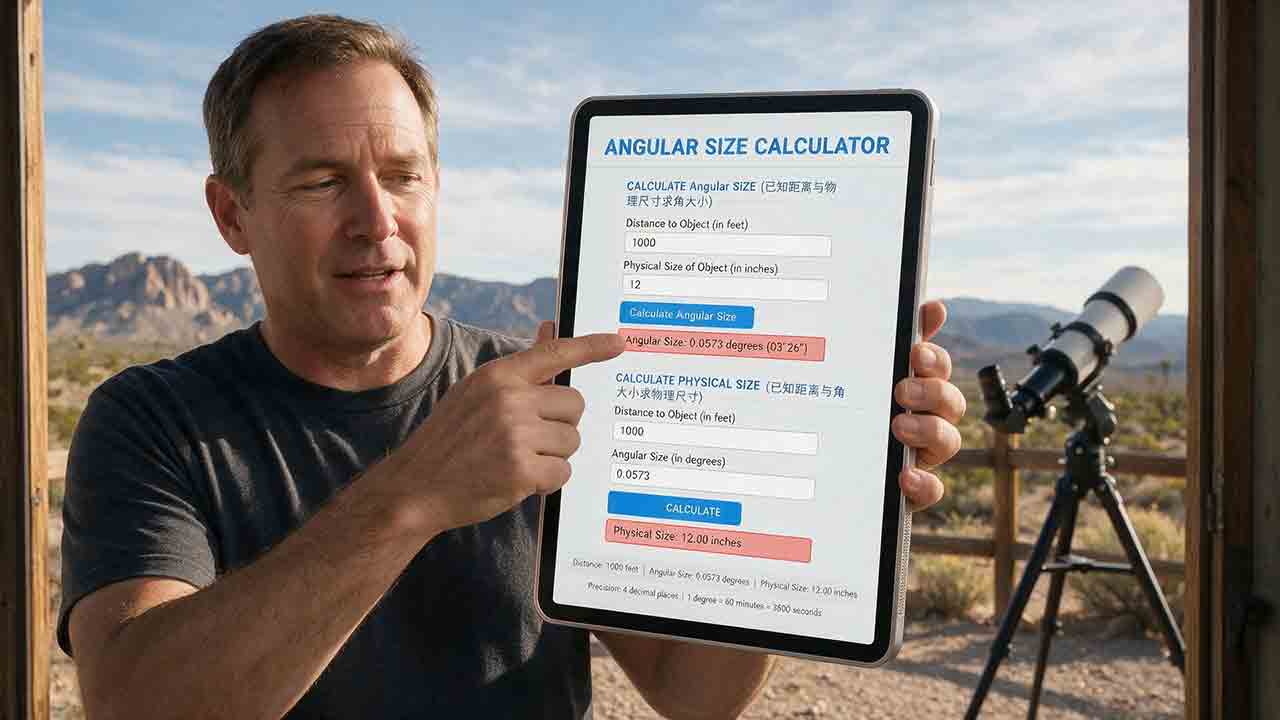
Angular Size Calculator
This guide explains how to calculate angular size, physical size, or distance using projected-width, spherical-limb, and small-angle geometry. It defines the correct distance for a flat projected width, distinguishes center distance for a spherical body, and shows when the small-angle approximation is accurate enough. Readers can verify calculator output with independent test values, a back-calculation check, worked Moon and deep-sky examples, and a reproducible approximation-error table. The article also covers radians, degrees, arcminutes, arcseconds, orientation, field of view, pixel coverage, uncertainty, catalog size differences, and angular-diameter distance in cosmology. Its Geometry–Quantity–Scale check and audit checklist help prevent radius-versus-diameter mistakes, mixed units, incorrect distance inputs, and confusion between angular size, resolution, and field of view.
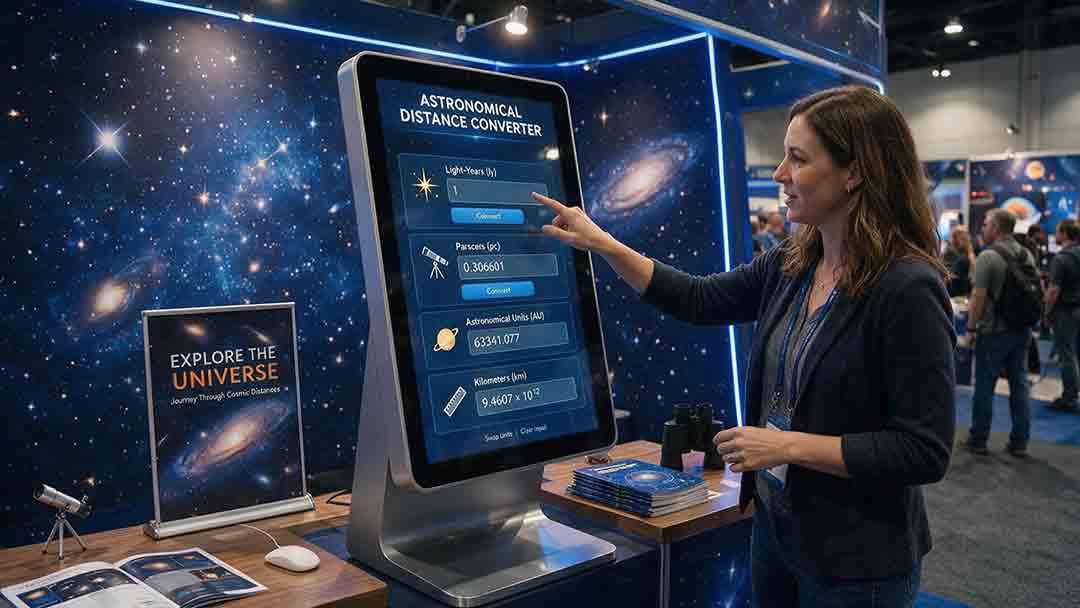
Astronomical Distance Converter
This article explains how to convert astronomical distances among meters, kilometers, international miles, astronomical units, light-seconds, light-minutes, light-hours, light-days, light-years, parsecs, kiloparsecs, megaparsecs, and gigaparsecs. It presents the common-base conversion formula, authoritative unit definitions, implementation test values, and a back-conversion check for verifying calculator accuracy. Readers also learn how to choose an appropriate unit with the Scale–Purpose–Precision framework, preserve significant figures, propagate uncertainty, and distinguish exact conversion constants from uncertain astronomical measurements. Worked examples cover Earth–Moon, stellar, and galactic scales, while the troubleshooting table addresses common prefix, rounding, and unit errors. The guide also clarifies why unit conversion alone cannot determine a planet’s current distance or turn redshift directly into a cosmological distance.
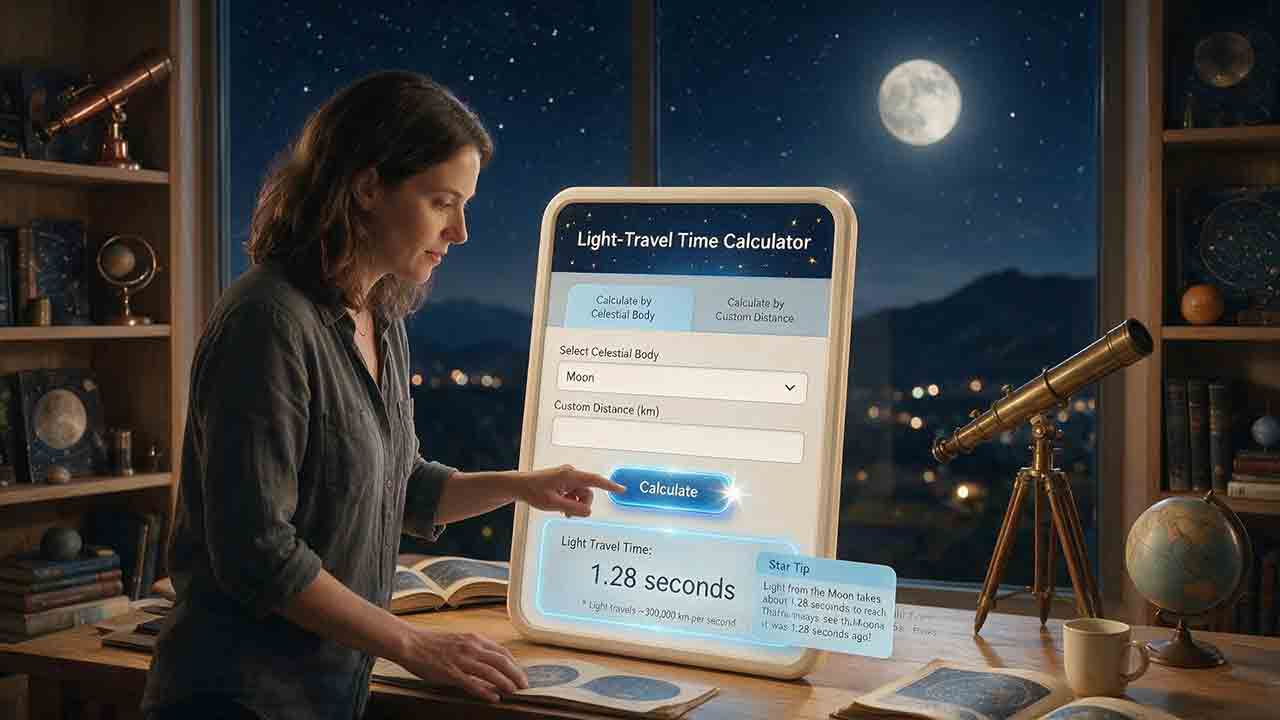
Light-Travel Time Calculator
This guide explains how to convert a known space distance into one-way or round-trip light-travel time using the exact SI speed of light. It covers meters, kilometers, international miles, astronomical units, light-based units, and parsecs, with transparent conversion standards and implementation test values. Readers learn how to distinguish observation, command, and conversation clocks; choose a distance that matches the correct observer, target, date, and signal direction; and avoid false precision when using rounded astronomical ranges. Worked Earth–Moon, one-AU, Earth–Mars, and stellar examples show how the calculation behaves in practical settings. The article also adds original decision tools, including a distance-source ladder, a three-clock framework, an error-diagnosis table, and a result-audit checklist. It explains why moving targets, relayed signals, material media, spacecraft operations, and cosmological distances may require models beyond a basic distance-divided-by-light-speed calculation.