Angular Size Calculator

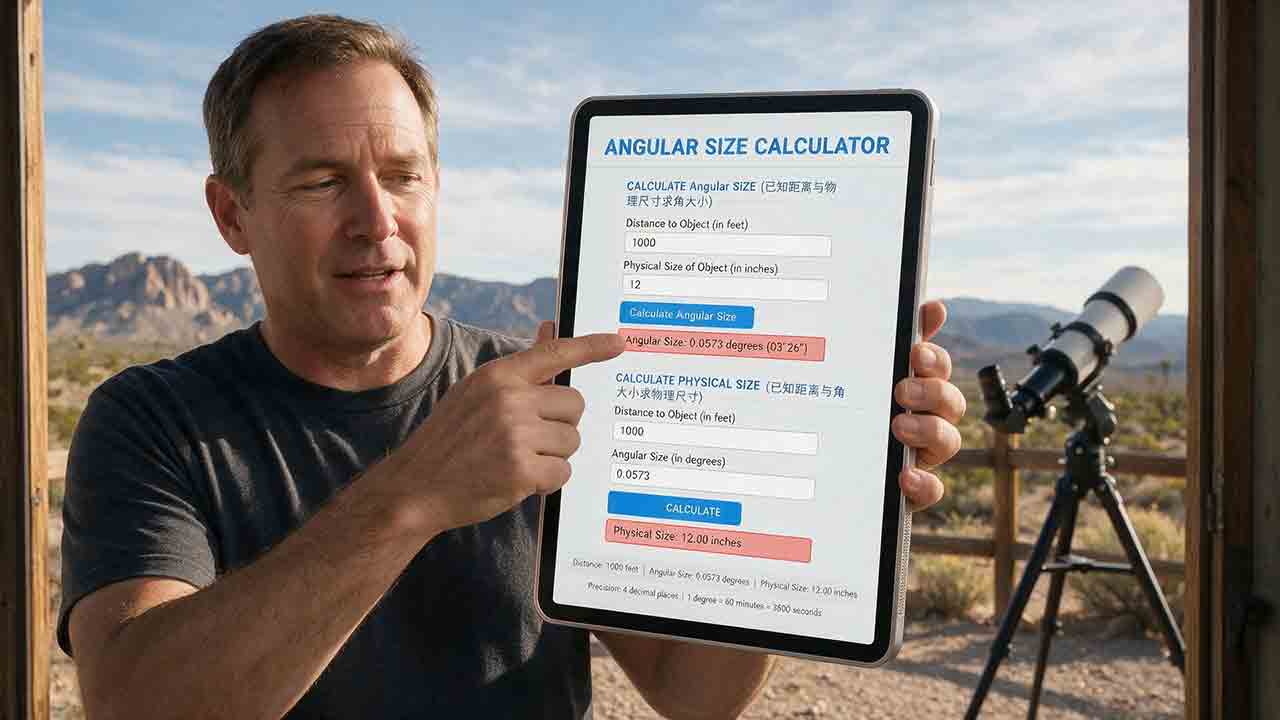
Angular Size Calculator
An angular size calculator finds how wide an object appears from a given viewpoint. Enter any two known quantities—physical transverse size, observer distance, or angular size—and solve for the third. Use exact projected-width geometry for a symmetric flat extent, spherical-limb geometry for a planet or moon, or the small-angle approximation when the object is much smaller than its distance.
Key Takeaways
- Angular size is the angle between lines of sight to opposite visible edges of an object.
- A projected flat width and a spherical body require different exact formulas at close range.
- The small-angle relationship (\theta\approx S/D) is highly accurate for most astronomical targets, provided (\theta) is expressed in radians.
- Physical size and distance must be converted into compatible linear units before calculation.
- Angular size alone cannot determine both physical size and distance; one of them must be known independently.
This guide shows how to select the correct geometry, calculate angular size, reverse the calculation, convert angular units, estimate approximation error, and recognize cases that require a more specialized model.
Calculation standard: Linear inputs are converted into compatible units before their ratio is calculated. Trigonometric functions use radians internally. Intermediate values are not rounded; rounding is applied only to the displayed result and should reflect the precision of the inputs.
Quick formula guide
- Use (\theta=2\arctan(S/2D)) for a symmetric width lying in a plane perpendicular to the central line of sight, where (D) is the perpendicular distance to that plane.
- Use (\theta=2\arcsin(S/2d)) for the tangent-limb diameter of a sphere, using center distance.
- Use (\theta\approx S/D) in radians when physical size is much smaller than distance.
- Use a model-derived angular-diameter distance for high-redshift cosmology.
What Can the Angular Size Calculator Solve?
The calculator supports three calculation modes.
| Known quantities | Calculated quantity |
|---|---|
| Physical size and distance | Angular size |
| Angular size and distance | Physical size |
| Physical size and angular size | Distance |
The appropriate geometry can be selected for each mode where mathematically applicable.
Supported Geometry Modes
- Projected width
- Spherical limb
- Small-angle approximation
Supported Angular Units
- radians
- degrees
- arcminutes
- arcseconds
- milliarcseconds
- microarcseconds
The calculator uses full angular diameter or full projected width unless a field is explicitly labeled as radius.
How Do You Use the Angular Size Calculator?
First select the unknown quantity. Enter the other two values, choose the geometry, and select the required input and output units.
Step 1: Decide What You Need to Calculate
Choose one of these questions:
- How large does the object appear?
- What physical width corresponds to the measured angle?
- How far away is an object of known size?
This choice determines which two fields are inputs and which field is the result.
Step 2: Identify the Correct Physical Size
Use the dimension extending across the line of sight.
Examples include:
- a planet’s diameter
- a crater’s width
- a galaxy’s major axis
- a spacecraft’s projected width
- the transverse extent of a nebula
- the width of a scale-model object
Do not use an object’s depth along the line of sight unless that depth also defines the visible transverse boundary.
Step 3: Define the Distance Correctly
The required distance depends on the selected model.
For projected-width geometry, use the shortest, perpendicular distance from the observer to the plane containing the width. The width’s midpoint must lie on the central line of sight for the symmetric formula used on this page.
For spherical-limb geometry, use the distance from the observer to the center of the sphere. Do not enter the distance to the near surface.
Step 4: Use Compatible Linear Units
Physical size and distance must use the same linear unit before division.
Valid combinations include:
- meters and meters
- kilometers and kilometers
- astronomical units and astronomical units
- light-years and light-years
- parsecs and parsecs
For example, a size of 1 kilometer and a distance of 100 meters must first be converted to the same unit. The calculator should not treat the raw ratio (1/100) as physically meaningful when the units differ.
Step 5: Select the Geometry
Choose:
- Projected width for a symmetric flat extent, image feature, straight target, or transverse dimension.
- Spherical limb for a spherical planet, moon, or star using center distance.
- Small-angle approximation for a distant target whose size is much smaller than its distance.
For most stars, galaxies, and nebulae, the small-angle model is sufficient. For a nearby planet, moon, laboratory target, or scale model, exact geometry may matter.
Step 6: Choose an Angular Unit
Use:
- degrees for large apparent extents
- arcminutes for Moon-sized fields
- arcseconds for planets and compact astronomical objects
- milliarcseconds or microarcseconds for precision astrometry
- radians for formulas and scientific calculations
Step 7: Interpret the Result
Angular size describes apparent extent from one observer position.
It does not by itself determine:
- whether a telescope resolves fine detail
- whether an entire target fits within a two-dimensional camera frame
- how bright or detectable the target is
- where a diffuse object’s physical edge should be defined
- both physical size and distance simultaneously
How Is Angular Size Calculated for a Projected Width?
Consider a straight width (S) lying in a plane perpendicular to the central line of sight. Its midpoint lies on that line, and its two endpoints are located symmetrically at transverse offsets (+S/2) and (-S/2).
Let (D) be the perpendicular distance from the observer to the width’s plane. Equivalently, (D) is the distance from the observer to the width’s midpoint.
Then:
[\tan\left(\frac{\theta}{2}\right)\frac{S}{2D}]
and:
[\theta2\arctan\left(\frac{S}{2D}\right)]
where:
- (\theta) is the full angular width
- (S) is the full projected physical width
- (D) is the perpendicular distance to the plane containing the width
The formula is exact for this symmetric planar geometry.
The observer-to-endpoint distance is not (D). Each endpoint has the longer slant distance:
[r\sqrt{D^2+\left(\frac{S}{2}\right)^2}]
The angular-size formula uses (D) because the right triangle is constructed from the perpendicular distance and half-width—not because each edge lies at a radial range equal to (D).
NASA’s Fermi educational guide to the small-angle relationship presents the projected-diameter geometry and its distant-object approximation.
Solving for Physical Size
When angular size and perpendicular distance are known:
[S2D\tan\left(\frac{\theta}{2}\right)]
Solving for Distance
When physical size and angular size are known:
[D\frac{S}{2\tan\left(\frac{\theta}{2}\right)}]
Convert the angular input to radians before applying either inverse formula.
When Is This Formula Not Exact?
A single perpendicular distance and width may not fully describe an object that is:
- tilted at close range
- curved
- strongly asymmetric
- extended significantly along the line of sight
- not centered on the selected line of sight
- defined by endpoints that do not lie in the same perpendicular plane
In those cases, calculate the actual lines of sight to the two visible boundaries or use a geometry-specific perspective model.
For arbitrary endpoint position vectors (\mathbf{r}_1) and (\mathbf{r}_2), the full angle between the boundaries can be calculated from:
[\theta\arccos\left(\frac{\mathbf{r}_1\cdot\mathbf{r}_2}{\lVert\mathbf{r}_1\rVert\lVert\mathbf{r}_2\rVert}\right)]
This vector form handles unequal endpoint ranges but requires complete positional information.
How Is Angular Diameter Calculated for a Sphere?
For an opaque sphere of radius (R), observed from a point outside the sphere at center-to-observer distance (d), the full angular diameter between the tangent limbs is:
[\theta_{\text{sphere}}2\arcsin\left(\frac{R}{d}\right)]
Using full diameter (S=2R):
[\theta_{\text{sphere}}=2\arcsin\left(\frac{S}{2d}\right)]
The model requires:[d>R]
The calculator expects center distance, not distance to the near surface.
NASA/JPL defines apparent diameter for modeled solar-system bodies as the angle subtended by a sphere centered on the target. The geometry is documented in the JPL NAIF apparent-diameter reference.
Solving for Spherical Diameter
When center distance and angular diameter are known:
[S2d\sin\left(\frac{\theta}{2}\right)]
Solving for Center Distance
When spherical diameter and angular diameter are known:
[d\frac{S}{2\sin\left(\frac{\theta}{2}\right)}]
In the mathematical limit:
[d\rightarrow R^+]
the apparent angular diameter approaches:
[180^\circ]
Why Do the Flat-Width and Sphere Formulas Differ?
A projected flat width ends at two fixed edge points. The visible edge of a sphere is formed by tangent lines touching a curved surface.
That difference produces:
[\theta_{\text{flat}}=2\arctan\left(\frac{S}{2D}\right)]
but:
[\theta_{\text{sphere}}2\arcsin\left(\frac{S}{2d}\right)]
The formulas converge when the object is distant compared with its size. At close range, the distinction can be substantial.
Close-Range Comparison
Suppose the same numerical ratio is used:
[\frac{S}{D}=1]
For projected-width geometry:
[\theta_{\text{flat}}2\arctan(0.5)\approx53.13^\circ]
For a sphere whose diameter equals its center distance:
[\theta_{\text{sphere}}2\arcsin(0.5)60^\circ]
The difference is almost seven degrees. Selecting the correct geometry is therefore more important than adding extra decimal places.
How Does the Small-Angle Approximation Work?
When an object is much smaller than its distance:
[\theta_{\text{rad}}\approx\frac{S}{D}]
where (\theta_{\text{rad}}) is expressed in radians.
The inverse forms are:
[S\approxD\theta_{\text{rad}}]
and:
[D\approx\frac{S}{\theta_{\text{rad}}}]
This approximation is widely useful in astronomy because celestial objects are generally extremely distant compared with their diameters.
Small-Angle Formula in Arcseconds
One radian contains:
[\frac{648{,}000}{\pi}\approx206{,}264.806247]
arcseconds.
Therefore:
[\theta_{\text{arcsec}}\approx206{,}264.806247\frac{S}{D}]
The inverse forms are:
[S\approxD\frac{\theta_{\text{arcsec}}}{206{,}264.806247}]
and:
[D\approx206{,}264.806247\frac{S}{\theta_{\text{arcsec}}}]
Size and distance must still use compatible linear units.
When Is the Small-Angle Approximation Accurate Enough?
For a projected width, the approximation slightly overestimates the exact angle because:
[\arctan(x)<x]
For a spherical limb, it slightly underestimates the exact angle because:
[\arcsin(x)>x]
The error direction therefore depends on the selected geometry.
How the Projected-Width Error Is Calculated
For the projected-width model:
[\theta_{\text{exact}}2\arctan\left(\frac{S}{2D}\right)]
[\theta_{\text{approx}}=\frac{S}{D}]
The relative approximation error is:
[\frac{\theta_{\text{approx}}-\theta_{\text{exact}}}{\theta_{\text{exact}}}\times100%]
Independently Calculated Accuracy Table
| Size-to-distance ratio (S/D) | Exact projected angle | Relative overestimate |
|---|---|---|
| 0.001 | (0.057296^\circ) | (0.000008%) |
| 0.01 | (0.572953^\circ) | (0.000833%) |
| 0.05 | (2.864192^\circ) | (0.0208%) |
| 0.10 | (5.724810^\circ) | (0.0833%) |
| 0.20 | (11.421186^\circ) | (0.332%) |
| 0.50 | (28.072487^\circ) | (2.05%) |
| 1.00 | (53.130102^\circ) | (7.84%) |
Practical Accuracy Rule
- If (S/D<0.01), projected-width error is below about (0.001%).
- If (S/D<0.10), projected-width error is below about (0.084%).
- If an object spans tens of degrees, use exact geometry.
- If a nearby object is spherical, use the spherical-limb model rather than treating its diameter as a flat width.
Most astronomical targets viewed from Earth are well within the small-angle range.
Which Angular-Size Method Should You Use?
| Situation | Method | Main advantage | Main limitation |
|---|---|---|---|
| Distant star, nebula, or galaxy | Small-angle approximation | Simple and highly accurate | Requires radians and a sufficiently small angle |
| Symmetric flat width in a perpendicular plane | Exact projected-width formula | Valid at large angles for the stated planar geometry | Requires a centered width and perpendicular plane distance |
| Planet, moon, or spherical body | Exact spherical-limb formula | Models tangent limbs correctly | Assumes a sphere and center distance |
| Tilted thin disk in the far field | Projected major and minor axes | Accounts for foreshortening | Not an exact close-range perspective model |
| Irregular or off-center object | Boundary-ray or vector calculation | Allows unequal endpoint positions and ranges | Requires full geometric information |
| High-redshift galaxy | Small-angle relation with (D_A) | Uses the correct cosmological distance concept | Requires a stated cosmological model |
| Unknown physical size and unknown distance | No unique solution | — | Another independent measurement is required |
The Geometry–Quantity–Scale Check
Before using a result, confirm:
- Geometry: Is the input a projected width, spherical diameter, or irregular boundary?
- Quantity: Are you solving for angle, physical size, or distance?
- Scale: Is the angle small enough for the approximation, or is exact geometry required?
This three-part check prevents most radius-versus-diameter, unit, and model-selection errors.
How Are Radians, Degrees, Arcminutes, and Arcseconds Related?
The coherent SI unit of plane angle is the radian. NIST defines a radian using the ratio of arc length to radius.
The exact relationship is:
[360^\circ2\pi\ \text{rad}]
Therefore:
[1^\circ\frac{\pi}{180}\ \text{rad}]
Angular subdivisions are:
[1^\circ60']
[1'60'']
[1^\circ3{,}600'']
Exact radian relationships include:
[1'\frac{\pi}{10{,}800}\ \text{rad}]
[1''\frac{\pi}{648{,}000}\ \text{rad}]
| Angular unit | Equivalent value |
|---|---|
| 1 radian | (57.295779513^\circ) |
| 1 radian | (3{,}437.746771') |
| 1 radian | (206{,}264.806247'') |
| 1 degree | (0.01745329252) rad |
| 1 arcminute | (0.000290888209) rad |
| 1 arcsecond | (4.848136811\times10^{-6}) rad |
| 1 milliarcsecond | (10^{-3}) arcsecond |
| 1 microarcsecond | (10^{-6}) arcsecond |
Authoritative definitions and conversions are available in NIST SP 330, Section 5 and the NIST angle conversion table.
Which Values Can Verify the Calculator?
The following cases can be used to test an implementation independently.
| Test input and geometry | Expected full angular size |
|---|---|
| Projected width 1 m at perpendicular distance 100 m | (0.572953021^\circ) |
| Projected width 1 m at perpendicular distance 1,000 m | (0.057295775^\circ) |
| Projected width 1 km at perpendicular distance 1,000 km | (206.264789'') |
| Projected width 1 unit at perpendicular distance 1 unit | (53.130102354^\circ) |
| Sphere radius 1 unit at center distance 2 units | exactly (60^\circ) |
| Small-angle ratio (S/D=10^{-6}) | approximately (0.206264806'') |
| 1 radian converted to arcseconds | (206{,}264.806247'') |
| 1 degree converted to arcseconds | exactly (3{,}600'') |
Extended decimals are intended for implementation checking. User-facing output should reflect the precision of the physical-size and distance inputs.
Back-Calculation Test
A reliable calculator should recover the original input when an output is passed through the matching inverse formula without intermediate rounding.
For projected-width geometry:
[S\rightarrow\theta\rightarrowS']
should produce:
[S'\approx S]
For example, with:
[S=1\ \text{m}]
and perpendicular plane distance:
[D=100\ \text{m}]
the forward result is:
[\theta\approx0.5729530206^\circ]
Using:
[S'=2D\tan\left(\frac{\theta}{2}\right)]
returns approximately 1 meter.
Worked Example 1: The Moon at a Representative Distance
Using a representative lunar mean radius of 1,737.4 km and average center distance of 384,400 km:
[\theta2\arcsin\left(\frac{1{,}737.4}{384{,}400}\right)]
[\theta\approx0.517929^\circ]
Converting to arcminutes:
[0.517929\times60\approx31.08']
The representative lunar angular diameter is therefore approximately:
[31.1\ \text{arcminutes}]
NASA commonly describes the Moon as roughly half a degree across. Its precise apparent diameter changes because its distance changes during its orbit.
How Much Can the Moon’s Apparent Diameter Change?
Using representative center distances from 356,400 km to 406,700 km:
| Center distance | Calculated spherical angular diameter |
|---|---|
| 356,400 km | approximately (33.52') |
| 384,400 km | approximately (31.08') |
| 406,700 km | approximately (29.37') |
The Moon’s physical radius is effectively constant over one orbit. The apparent-size change is primarily a distance effect.
Reference lunar dimensions and distance information are available from NASA Moon Facts and the NASA Daily Moon Guide.
Worked Example 2: A One-Meter Target at 100 Meters
Suppose a symmetric flat target is 1 meter wide and lies in a plane perpendicular to the central line of sight. Its midpoint plane is 100 meters from the observer.
Use:
[\theta=2\arctan\left(\frac{1}{2\times100}\right)]
[\theta\approx0.00999991667\ \text{rad}]
Converting to degrees:
[\theta\approx0.572953^\circ]
or:
[\theta\approx34.3772']
The distance from the observer to either endpoint is slightly greater than 100 meters:
[r\sqrt{100^2+0.5^2}\approx100.00125\ \text{m}]
The formula nevertheless uses the perpendicular plane distance (D=100\ \text{m}).
The small-angle estimate is:
[\theta\approx\frac{1}{100}=0.01\ \text{rad}]
The relative difference from the exact projected-width result is approximately:
[0.000833%]
Worked Example 3: Finding a Nebula’s Physical Width
Suppose a nebula is 1,500 light-years away and spans 45 arcseconds.
Convert the angle to radians:
[\theta\frac{45}{206{,}264.806247}]
[\theta\approx2.18166\times10^{-4}\ \text{rad}]
Using:
[S\approxD\theta]
gives:
[S\approx1{,}500\times2.18166\times10^{-4}\ \text{ly}]
[S\approx0.327\ \text{ly}]
This is approximately:
[0.100\ \text{pc}]
or:
[20{,}700\ \text{au}]
The result assumes that 1,500 light-years is the appropriate object distance and that 45 arcseconds represents the selected transverse boundary.
Worked Example 4: Finding Distance From Angular Size
Suppose an object is 1,000 km wide and appears 0.2 arcseconds across.
Convert the angle to radians:
[\theta0.2\frac{\pi}{648{,}000}]
[\theta\approx9.69627\times10^{-7}\ \text{rad}]
Using the exact projected-width inverse:
[D=\frac{1{,}000}{2\tan(\theta/2)}]
[D\approx1.0313\times10^9\ \text{km}]
That is approximately:
[6.89\ \text{au}]
Because the angle is extremely small, the small-angle inverse produces the same result at the displayed precision.
How Does Object Orientation Affect Angular Size?
Angular-size calculations use the physical dimension projected across the line of sight.
For a geometrically thin circular disk under orthographic projection—or when its distance is much greater than its diameter—the projected axes are:
[S_{\text{major}}S][S_{\text{minor}}S\cos i]
where:
- (S) is the true disk diameter
- (i=0^\circ) is face-on
- (i=90^\circ) is edge-on
Calculate the major-axis and minor-axis angular sizes separately.
For a nearby tilted disk with significant perspective, different parts of the disk lie at different distances. The apparent outline is then not described exactly by one common distance and (S\cos i); a full perspective or ray-based model is required.
For irregular objects, identify the measured direction, such as:
- major-axis diameter
- minor-axis diameter
- north–south extent
- east–west extent
- maximum detectable width
- full width at half maximum
A single angular-size value may not describe the complete shape.
Why Can Catalogs Report Different Angular Sizes?
A solid planet has a relatively clear limb. A galaxy, nebula, or comet often has no single physical edge.
Reported sizes can differ because of:
| Cause | Effect |
|---|---|
| Observing wavelength | Different material may dominate in radio, infrared, visible, ultraviolet, or X-ray data |
| Brightness threshold | Faint outer structure may be included or excluded |
| Atmospheric seeing | Small features can be blurred in ground-based observations |
| Instrument resolution | An unresolved source may appear no smaller than the point-spread function |
| Background subtraction | Processing can change the detectable boundary |
| Object orientation | Major and minor axes differ |
| Time variability | Comae, jets, remnants, and moving targets can change |
| Size definition | Diameter, radius, FWHM, and isophotal extent are not interchangeable |
The calculator uses the boundary supplied by the user. It cannot determine which observational definition is most appropriate for a research question.
How Is Angular Size Different From Field of View and Resolution?
| Quantity | Meaning |
|---|---|
| Angular size | Apparent span of one object |
| Angular diameter | Full angle between opposite edges |
| Angular radius | Half the angular diameter |
| Angular separation | Angle between two sky positions |
| Field of view | Total angular width or area visible through an instrument |
| Angular resolution | Smallest separation or feature an instrument can distinguish |
| Pixel scale | Angular width represented by one image pixel |
| Solid angle | Two-dimensional angular area measured in steradians |
An object can be large enough to span many arcseconds while still containing details too fine for a telescope to resolve.
Angular size answers:
How much of the sky does the object cover?
Angular resolution answers:
How small a feature can the instrument distinguish?
How Can Angular Size Help With Imaging Plans?
Comparing Angular Size With Field of View
For a one-dimensional comparison:
[\theta_{\text{object}}<\theta_{\text{field}}]
is required along the same axis.
For a rectangular sensor or elongated target, compare:
- object width with horizontal field
- object height with vertical field
- major and minor axes with the corresponding frame dimensions
Camera rotation can determine whether a long object fits. Allow additional margin for framing, tracking drift, uncertain boundaries, and mosaic overlap.
Estimating Image Coverage
If an object spans (\theta) arcseconds and the image scale is (p) arcseconds per pixel:
[N_{\text{pixels}}\approx\frac{\theta}{p}]
For example, an object 120 arcseconds wide at 1.5 arcseconds per pixel spans:
[\frac{120}{1.5}80\ \text{pixels}]
This estimates coverage, not resolved detail.
Magnification changes how large a target appears through an optical system, but it does not change the target’s true angular size on the sky. Use the Telescope Magnification Calculator for eyepiece and magnification planning.
How Does Cosmology Change Angular-Size Calculations?
For a high-redshift galaxy, the relevant distance is the angular-diameter distance:
[D_A\frac{S}{\theta_{\text{rad}}}]
Angular-diameter distance is not automatically equal to:
- luminosity distance
- comoving distance
- light-travel distance
- present-day proper distance
The NASA/IPAC reference on distance measures in cosmology defines angular-diameter distance as transverse physical size divided by angular size in radians.
At cosmological scales, distance depends on the selected cosmological model and parameters. A general angular size calculator should accept a previously calculated (D_A), not treat redshift as a distance.
How Does Input Uncertainty Affect Angular Size?
For the small-angle relationship:
[\theta\frac{S}{D}]
and independent size and distance uncertainties:
[\left(\frac{\sigma_\theta}{\theta}\right)^2\approx\left(\frac{\sigma_S}{S}\right)^2+\left(\frac{\sigma_D}{D}\right)^2]
If physical size has 3% uncertainty and distance has 4% uncertainty:
[\frac{\sigma_\theta}{\theta}\approx\sqrt{0.03^2+0.04^2}]
[\frac{\sigma_\theta}{\theta}\approx0.05]
The estimated angular size therefore has approximately 5% relative uncertainty.
This rule assumes independent uncertainties and a valid small-angle model. Correlated inputs or model-derived quantities require a fuller uncertainty analysis.
Common Angular-Size Errors and Troubleshooting
| Problem | Likely cause | What to check |
|---|---|---|
| Result is about 57.3 times too large or small | Degrees were used where radians were required | Convert the angle before applying the formula |
| Result is twice the expected value | Radius and diameter were confused | Confirm whether the input is radius or full diameter |
| Result is 1,000 times wrong | Linear units were mixed | Convert size and distance to compatible units |
| Nearby spherical target looks too small | Projected-width geometry was selected | Use spherical-limb geometry |
| Flat-target result is slightly inconsistent | Endpoint slant distance was entered as (D) | Use perpendicular plane distance, not endpoint range |
| Result differs slightly from another calculator | One tool uses the small-angle approximation | Compare formulas and rounding |
| Moon or planet size changes with date | Observer-to-target distance changes | Use a date-specific ephemeris |
| Major and minor sizes differ | The object is inclined or irregular | Calculate both projected axes |
| Catalog size changes by wavelength | Different material or thresholds define the edge | Compare bandpass and size definition |
| Object fits but detail is blurred | Field of view was confused with resolution | Check angular resolution and pixel scale |
| Galaxy result is implausible | The wrong cosmological distance was used | Use angular-diameter distance |
| Output contains unsupported decimals | Calculator precision exceeds input precision | Apply appropriate significant figures |
| No unique solution exists | Both physical size and distance are unknown | Obtain another independent measurement |
| Spherical calculation fails | Center distance is not greater than radius | Confirm (d>R) and use center distance |
| Tilted nearby disk looks distorted | Orthographic projection was assumed | Use a perspective model |
Angular-Size Result Audit Checklist
Before publishing or relying on a result, confirm:
- The physical input is a transverse size.
- Radius and diameter are not confused.
- Size and distance use compatible linear units.
- Projected-width (D) is the perpendicular plane distance, not endpoint slant range.
- Spherical-limb distance is measured to the sphere’s center.
- Projected-width or spherical-limb geometry matches the target.
- Angular inputs are converted to radians before trigonometric calculations.
- The small-angle approximation is accurate enough for (S/D).
- Orientation and foreshortening have been considered.
- Both axes are compared when field-of-view fit is two-dimensional.
- Display precision matches input quality.
- Cosmological calculations use angular-diameter distance.
- Angular size is not being confused with field of view or resolution.
Practical Conclusion
Use the angular size calculator when two of these three quantities are known: physical transverse size, observer distance, and angular size. For most distant astronomical objects, (\theta\approx S/D) is accurate when the angle is expressed in radians. For a nearby target or large apparent angle, select the exact geometry matching the object.
For a symmetric projected width, enter the perpendicular distance to the width’s plane—not the longer slant range to either edge. Planetary observers should use spherical-limb geometry with a center distance appropriate to the observing date. Astrophotographers should compare both angular axes with field of view, pixel scale, and resolution. High-redshift work requires a model-derived angular-diameter distance.
Scope notice: This calculator is intended for education, observation planning, estimation, and general scientific reference. Precision spacecraft navigation, astrometric inference, optical engineering, and cosmological analysis require validated specialist data and methods.
Related Space Distance and Scale Tools
- Astronomical Distance Converter — convert physical-size and distance inputs into compatible linear units.
- Light-Travel Time Calculator — convert a known distance into vacuum propagation time.
- Telescope Magnification Calculator — compare a target with eyepiece magnification and field of view.
- Planet Distance Calculator — obtain or compare observer-to-planet distances.
- Solar System Scale Calculator — translate large diameters and distances into proportional models.
Frequently Asked Questions
Is Angular Size the Same as Physical Size?
No. Physical size is a length, while angular size is the angle that the object spans from a particular observer position.
The same object appears smaller as its distance increases.
What Distance Should I Use for a Flat Projected Width?
Use the perpendicular distance from the observer to the plane containing the width. When the width is centered on the line of sight, this is also the distance to its midpoint.
Do not use the slightly longer slant distance from the observer to either endpoint.
Why Must the Small-Angle Formula Use Radians?
The relationship:
[\theta\approx\frac{S}{D}]
is valid when (\theta) is in radians. Using degrees directly introduces an error factor of approximately (180/\pi), or 57.3.
Can Two Objects Have the Same Angular Size but Different Physical Sizes?
Yes. A small nearby object and a much larger distant object can subtend the same angle.
Angular size alone cannot determine both distance and physical size.
Why Does the Moon’s Angular Diameter Change?
The Moon’s orbit is not circular, so its distance from Earth changes. Because angular diameter depends on physical diameter divided by distance, the Moon appears slightly larger when nearer and smaller when farther away.
Can Redshift Be Entered as the Distance?
No. Redshift is dimensionless and does not correspond to one unique distance through a fixed conversion.
A cosmological model must first provide the angular-diameter distance for the selected parameters.
Sources
National Institute of Standards and Technology — SP 330, Section 5: Plane Angles
Defines the radian and its relationship to plane angle. Accessed August 1, 2026.National Institute of Standards and Technology — Angle Conversion Factors
Reference conversions among radians, degrees, arcminutes, and arcseconds. Accessed August 1, 2026.NASA Goddard Space Flight Center — Fermi Learning Center: Small-Angle Approximation
Explains the relationship among angular diameter, physical diameter, and distance. Accessed August 1, 2026.NASA/JPL NAIF — Find Apparent Diameter
Documents apparent-diameter geometry for a spherical target model. Accessed August 1, 2026.NASA Science — Moon Facts
Reference values for lunar radius and representative Earth–Moon distance. Accessed August 1, 2026.NASA Science — Daily Moon Guide
Provides date-dependent lunar distance and angular-diameter information. Accessed August 1, 2026.NASA Science — Universe Glossary
Definitions of arcminutes, arcseconds, and related astronomical terminology. Accessed August 1, 2026.European Space Agency — Cosmic Distances
Context for arcseconds, milliarcseconds, and microarcseconds in astronomy. Accessed August 1, 2026.NASA/IPAC Extragalactic Database — Distance Measures in Cosmology
Defines angular-diameter distance and its relationship to transverse physical size. Accessed August 1, 2026.NASA/JPL Education — Planet Pinpointer
Educational application of the small-angle formula to an astronomical target. Accessed August 1, 2026.
More from Space Distance & Scale Tools
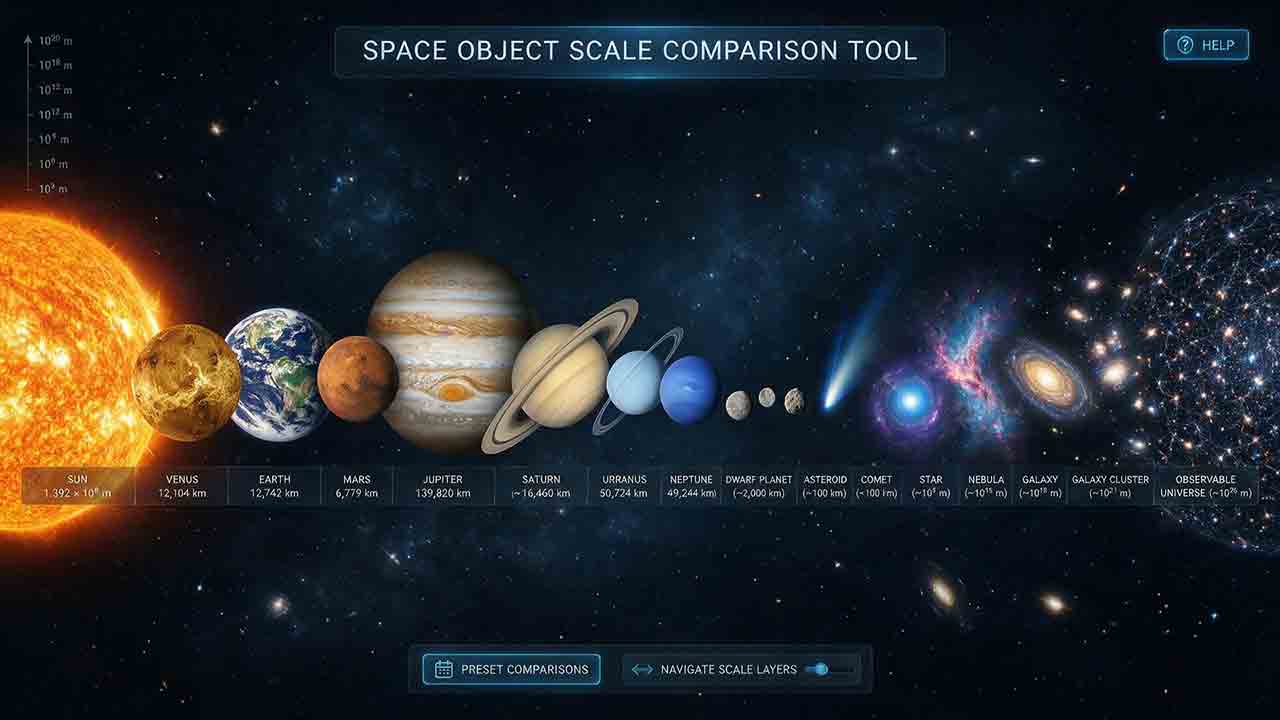
Space Object Scale Comparison Tool
This guide explains how to compare the physical sizes of Bennu, Ceres, Pluto, the Moon, the eight planets, and the Sun on one consistent linear scale. It defines the verified preset objects, distinguishes mean diameter from nominal or approximate width, and shows how to calculate diameter ratios, reference percentages, and scaled model sizes. Original value comes from the Definition–Ratio–Resolution Framework, the Scale-Span Problem, reversible ratio checks, and clear labels for reference-circle area and reference-sphere volume derivations. Worked examples include an Earth-at-10-centimeters model and the visibility limits created by the Sun-to-Bennu size span. The article also explains why rings, comet comae, exoplanets, diffuse nebulae, and black-hole boundaries require custom definitions rather than ordinary planet-diameter presets. Readers gain a practical method for building accurate classroom models, tables, and visualizations without mixing physical size, mass, orbital distance, or angular size.
Planet Weight Calculator
This guide explains how a planet weight calculator separates unchanged mass from gravitational force and standard-Earth force equivalents. It shows how to calculate weight with W = mg, interpret kilograms, pound-mass, newtons, pound-force, kg-equivalent, and lb-equivalent, and understand why local scale readings depend on instrument calibration. Sourced gravity presets cover the eight planets, the Moon, and Pluto, with clear warnings for giant planets that have no solid surface. Worked examples, verification values, altitude limits, custom-planet formulas, uncertainty propagation, and the original Reference–Instrument–Support Check help readers evaluate results without confusing force, mass, apparent weight, or reference gravity. The article also explains free fall, reference radii, Pluto data differences, and when a body-specific gravity model is required.
Astronomical Distance Converter
This article explains how to convert astronomical distances among meters, kilometers, international miles, astronomical units, light-seconds, light-minutes, light-hours, light-days, light-years, parsecs, kiloparsecs, megaparsecs, and gigaparsecs. It presents the common-base conversion formula, authoritative unit definitions, implementation test values, and a back-conversion check for verifying calculator accuracy. Readers also learn how to choose an appropriate unit with the Scale–Purpose–Precision framework, preserve significant figures, propagate uncertainty, and distinguish exact conversion constants from uncertain astronomical measurements. Worked examples cover Earth–Moon, stellar, and galactic scales, while the troubleshooting table addresses common prefix, rounding, and unit errors. The guide also clarifies why unit conversion alone cannot determine a planet’s current distance or turn redshift directly into a cosmological distance.
Explore More Topics
Astrophotography Storage Calculator
This guide explains how to estimate storage for astrophotography capture, processing, and backup without relying on misleading megapixel shortcuts. It compares measured-file, uncompressed-array, and bitrate methods; distinguishes mean, median, high-percentile, and maximum file-size statistics; and explains decimal versus binary storage units. Readers learn how FITS headers, padding, HDUs, RAW compression, calibration frames, RGB conversion, drizzle, mosaics, caches, and temporary files affect project size. Original planning tools include the Four-Bucket Storage Ledger, the Capture–Process–Protect Check, and a clearly defined storage expansion ratio. Worked examples show how to calculate peak logical data, project-relative headroom, complete-copy footprint, media count, write rate, and transfer time. The article also covers integrity verification, backup limitations, retention decisions, and troubleshooting. It is designed to help astrophotographers build realistic capacity plans for single sessions, multi-night projects, planetary video, star trails, and long-term archives.
Star Trail Exposure Calculator
This guide explains how to calculate star-trail exposure time from Earth’s sidereal rotation, stellar declination, and local image scale. It distinguishes polar sweep, declination-adjusted sky-path length, projected pixel length, recorded sweep, missing sweep, and the full start-to-end span of a stacked sequence. Original tables compare trail lengths at several declinations, quantify one-second frame gaps at different image scales, and show how recorded time, gap time, duty cycle, and sequence sweep relate. The Trail–Frame–Sequence Check provides a practical framework for separating celestial geometry, per-frame reliability, and sequence continuity. Worked examples also address the celestial-pole edge case, local WCS-based pixel movement, frame-count limits, long-exposure noise reduction, and the difference between a single exposure and stacked frames. Readers can use the article to plan smoother trails, avoid misleading sequence calculations, and verify expected motion with native-resolution test images.
Camera Field of View Calculator
This guide explains how to calculate horizontal, vertical, and diagonal camera field of view from the recorded active sensor dimensions and effective focal length. It distinguishes physical focal length from crop-factor comparisons, shows why aspect ratio and target rotation affect framing, and provides independently calculated reference tables for common sensor sizes and focal lengths. The original Frame Envelope Check separates ideal frame geometry, the target envelope, and the usable frame retained after dithering, registration, distortion correction, and cropping. Worked examples demonstrate target occupancy, maximum permitted focal length, rotated bounding boxes, and mosaic panel counts with overlap. The article also explains radians versus degrees, crop and stabilization modes, focus breathing, rectilinear versus fisheye projection, and plate-solving verification through a celestial WCS. Readers can use the formulas, margin budget, troubleshooting table, and framing checklist to plan wide-field compositions, small-target imaging, or mosaics without treating a mathematical edge-to-edge fit as a guaranteed final frame.