Explore the Unknown

Discover the secrets of black holes, galaxies, and the origin of the universe.

Advertisement

Trending Now

Advertisement

Featured Articles

Latest and most popular articles from all categories
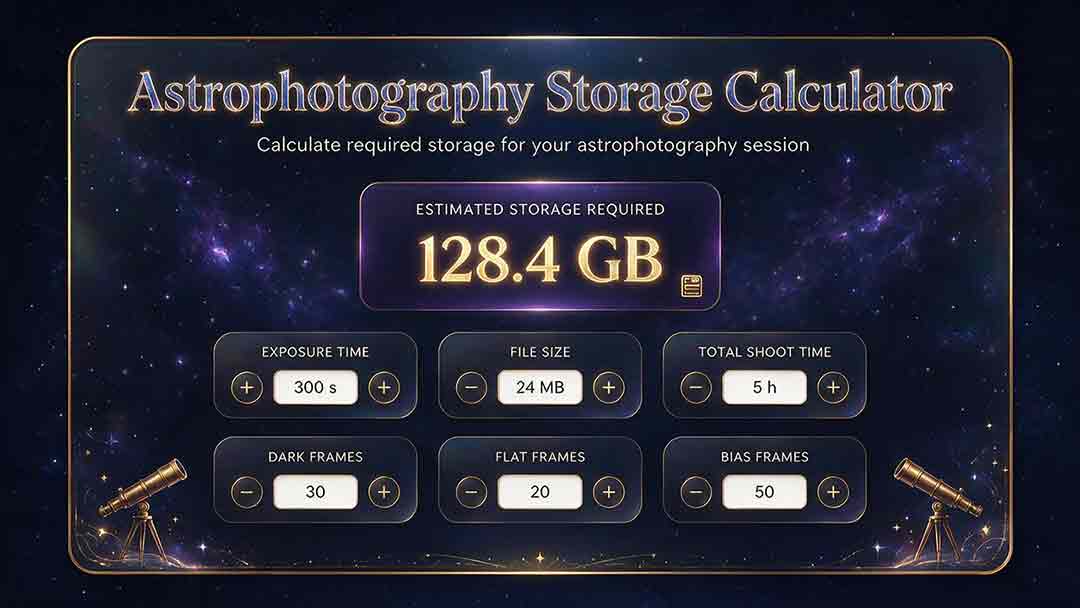
Astrophotography Planning ToolsAstrophotography Storage Calculator

Astrophotography Storage Calculator

This guide explains how to estimate storage for astrophotography capture, processing, and backup without relying on misleading megapixel shortcuts. It compares measured-file, uncompressed-array, and bitrate methods; distinguishes mean, median, high-percentile, and maximum file-size statistics; and explains decimal versus binary storage units. Readers learn how FITS headers, padding, HDUs, RAW compression, calibration frames, RGB conversion, drizzle, mosaics, caches, and temporary files affect project size. Original planning tools include the Four-Bucket Storage Ledger, the Capture–Process–Protect Check, and a clearly defined storage expansion ratio. Worked examples show how to calculate peak logical data, project-relative headroom, complete-copy footprint, media count, write rate, and transfer time. The article also covers integrity verification, backup limitations, retention decisions, and troubleshooting. It is designed to help astrophotographers build realistic capacity plans for single sessions, multi-night projects, planetary video, star trails, and long-term archives.

2025/08/275 minRead More
Astrophotography Planning ToolsStar Trail Exposure Calculator

Star Trail Exposure Calculator

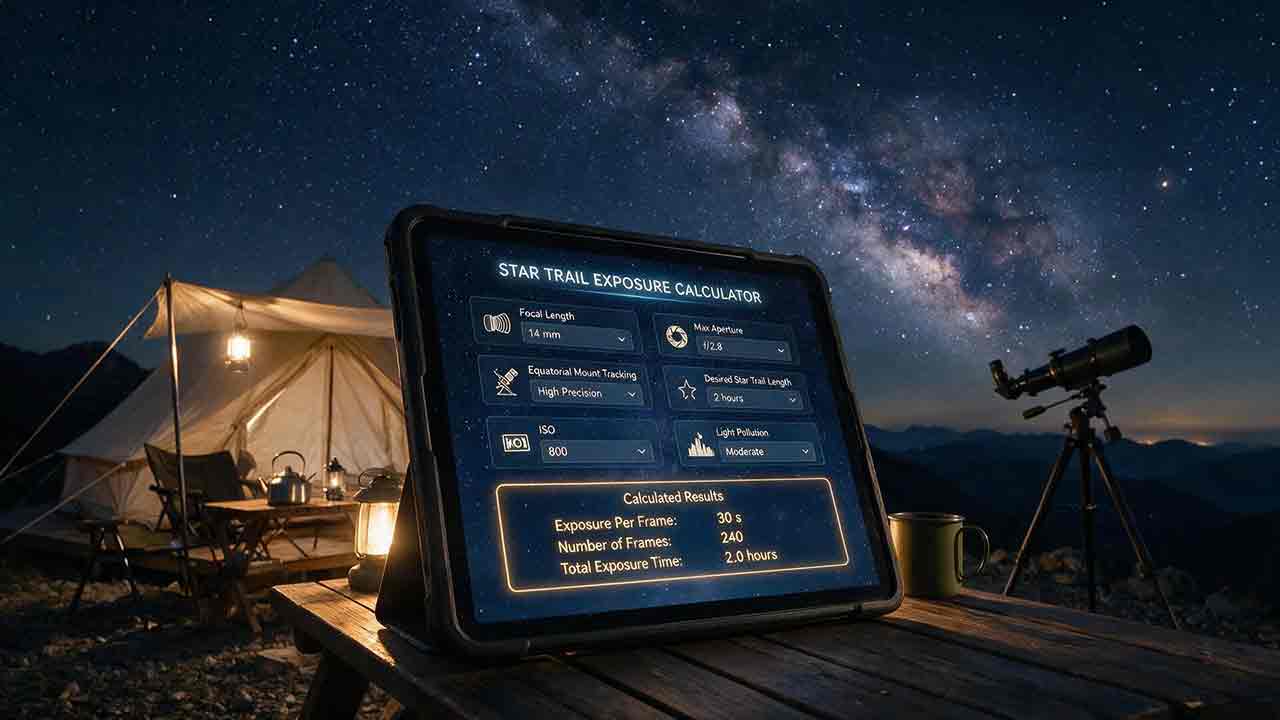
This guide explains how to calculate star-trail exposure time from Earth’s sidereal rotation, stellar declination, and local image scale. It distinguishes polar sweep, declination-adjusted sky-path length, projected pixel length, recorded sweep, missing sweep, and the full start-to-end span of a stacked sequence. Original tables compare trail lengths at several declinations, quantify one-second frame gaps at different image scales, and show how recorded time, gap time, duty cycle, and sequence sweep relate. The Trail–Frame–Sequence Check provides a practical framework for separating celestial geometry, per-frame reliability, and sequence continuity. Worked examples also address the celestial-pole edge case, local WCS-based pixel movement, frame-count limits, long-exposure noise reduction, and the difference between a single exposure and stacked frames. Readers can use the article to plan smoother trails, avoid misleading sequence calculations, and verify expected motion with native-resolution test images.

2025/08/205 minRead More
Astrophotography Planning ToolsCamera Field of View Calculator

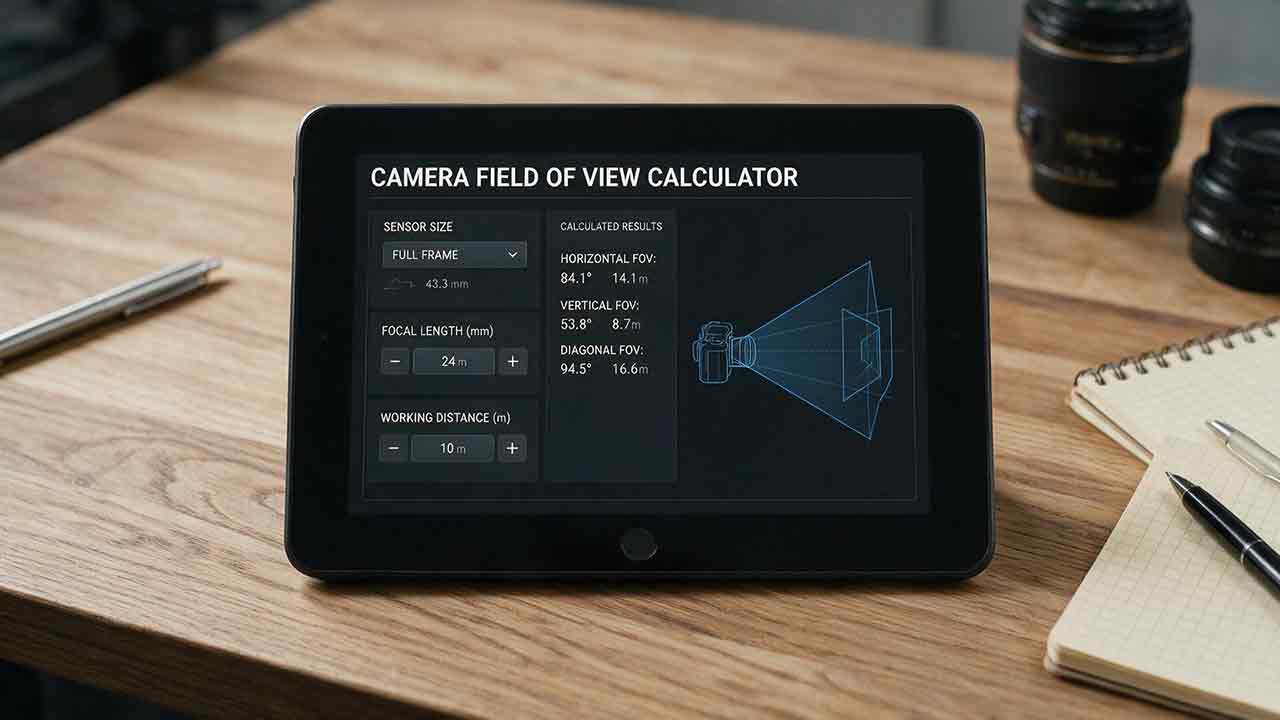
Camera Field of View Calculator

This guide explains how to calculate horizontal, vertical, and diagonal camera field of view from the recorded active sensor dimensions and effective focal length. It distinguishes physical focal length from crop-factor comparisons, shows why aspect ratio and target rotation affect framing, and provides independently calculated reference tables for common sensor sizes and focal lengths. The original Frame Envelope Check separates ideal frame geometry, the target envelope, and the usable frame retained after dithering, registration, distortion correction, and cropping. Worked examples demonstrate target occupancy, maximum permitted focal length, rotated bounding boxes, and mosaic panel counts with overlap. The article also explains radians versus degrees, crop and stabilization modes, focus breathing, rectilinear versus fisheye projection, and plate-solving verification through a celestial WCS. Readers can use the formulas, margin budget, troubleshooting table, and framing checklist to plan wide-field compositions, small-target imaging, or mosaics without treating a mathematical edge-to-edge fit as a guaranteed final frame.

2025/08/155 minRead More
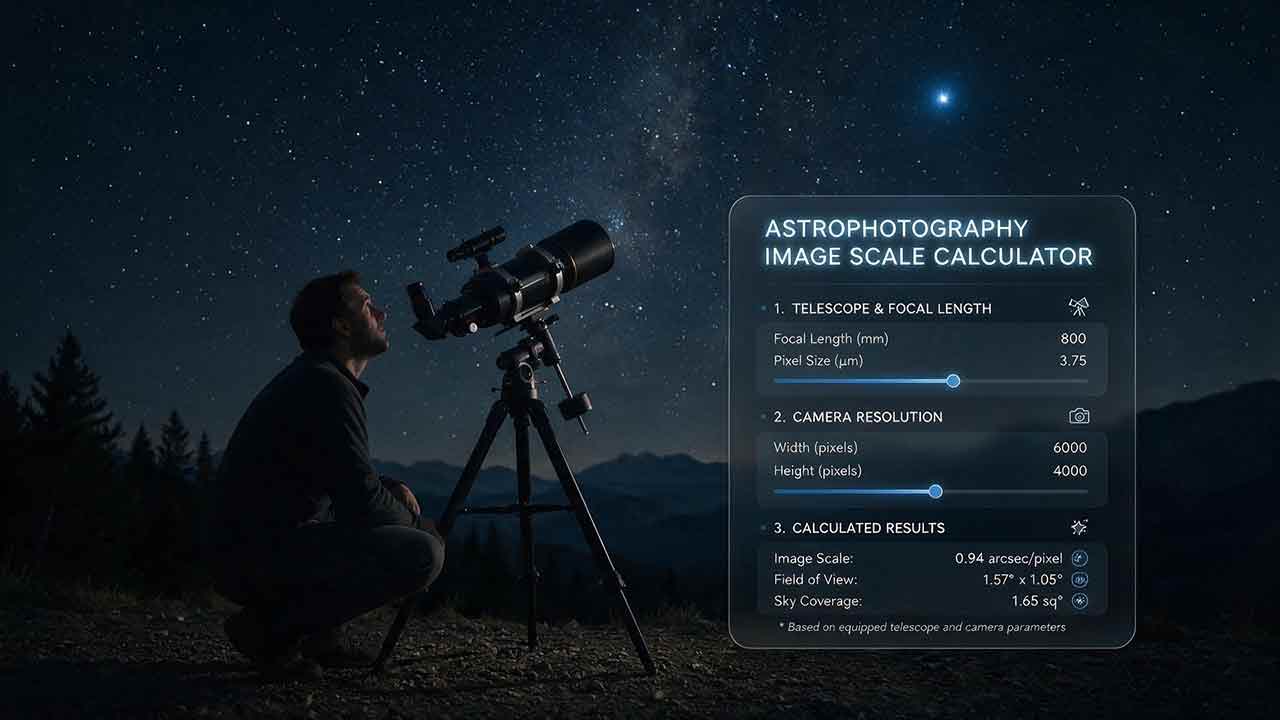
Astrophotography Planning ToolsAstrophotography Image Scale Calculator

Astrophotography Image Scale Calculator

This guide explains how to calculate astrophotography image scale from camera pixel size and effective focal length, then interpret the result without confusing detector sampling with true optical resolution. It covers correct inputs, non-square pixels, reducers, amplifiers, binning, resampling, field of view, plate scale terminology, and WCS-based verification. Two original reference tables compare image scale across common pixel pitches and focal lengths and show how delivered stellar FWHM translates into pixels per FWHM. The original Scale–Quality–Target Check provides a practical decision framework for matching sampling to real image quality and target detail. Reproducible guidance explains how to measure representative FWHM from native-resolution data, diagnose discrepancies between calculated and plate-solved scale, and derive a local effective focal length. The article also distinguishes wide-field, small-target, lunar, planetary, photometric, and astrometric use cases while avoiding universal purchasing claims or unsupported equipment-testing conclusions.

2025/08/065 minRead More
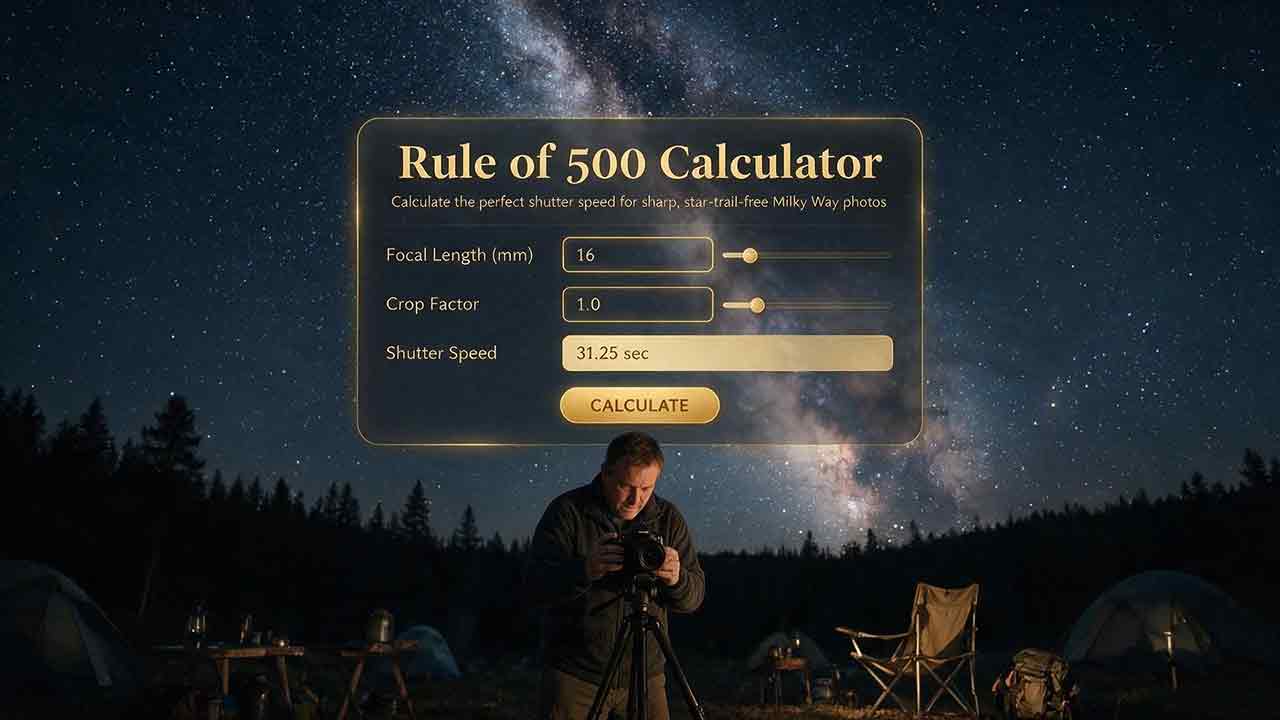
Astrophotography Planning ToolsRule of 500 Calculator for Milky Way Photography

Rule of 500 Calculator for Milky Way Photography

This guide explains how to use the Rule of 500 Calculator to estimate a starting shutter speed for untracked Milky Way photography. It shows how actual focal length and crop factor affect the calculation, why crop factor must not be applied twice, and how the Rule of 400 and Rule of 300 provide shorter alternatives. Original comparison tables quantify exposure times across common focal lengths and sensor formats, while a light-loss table shows the practical signal cost of shortening an exposure. The guide also introduces the Three-Limit Check, an original motion–optics–signal diagnostic framework for separating star movement from focus, lens, and noise problems. Calculation-based examples, rounding rules, input limits, troubleshooting guidance, and a field checklist help readers choose a camera-supported setting and verify it in a magnified test frame. The article relies on astronomy references, manufacturer documentation, and transparent calculations rather than claimed field tests of a specific camera or lens.

2025/07/315 minRead More
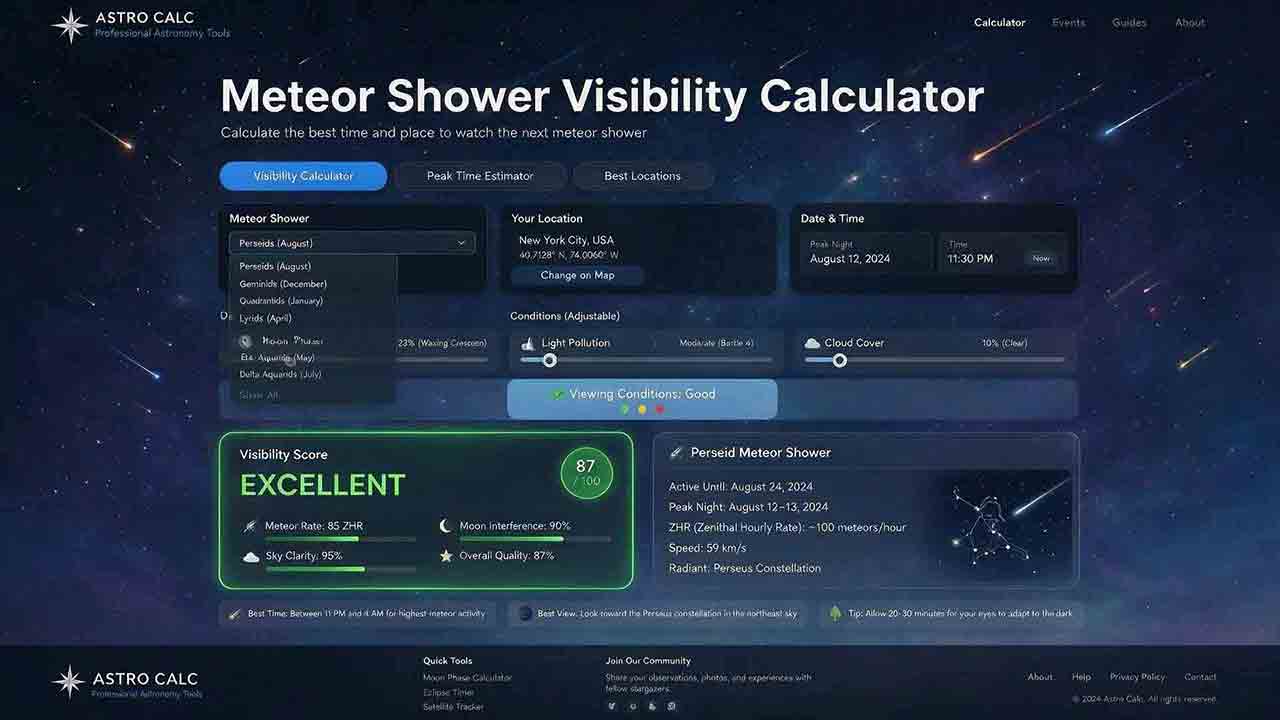
Sky & Time ToolsMeteor Shower Visibility Calculator

Meteor Shower Visibility Calculator

This guide explains how to use a meteor shower visibility calculator to identify a locally favorable observing window instead of relying only on a published peak time or Zenithal Hourly Rate. It covers activity periods, radiant altitude, astronomical darkness, Moon timing, weather, limiting magnitude, population index, and the distinction between named-shower members, sporadic meteors, and meteors from overlapping showers. The article introduces two original planning tools: the Five-Layer Meteor Test and the Meteor Opportunity Window, which calculates the overlap between activity, radiant, darkness, Moon, weather, and session constraints. A reproducible cross-midnight example compares illustrative 20° and 40° radiant thresholds, producing windows of 2 hours 20 minutes and 1 hour 40 minutes. Practical guidance addresses moonlight, viewing direction, dark adaptation, calculator disagreements, troubleshooting, and responsible site selection, supported by NASA, IMO, AMS, and U.S. Naval Observatory sources.

2026/06/105 minRead More
Advertisement

Science Deep Dive

High-quality long-form content exploring cosmic phenomena in depth
Planet Visibility Finder: Which Planets Can You See Tonight?
Sky & Time Tools

Planet Visibility Finder: Which Planets Can You See Tonight?

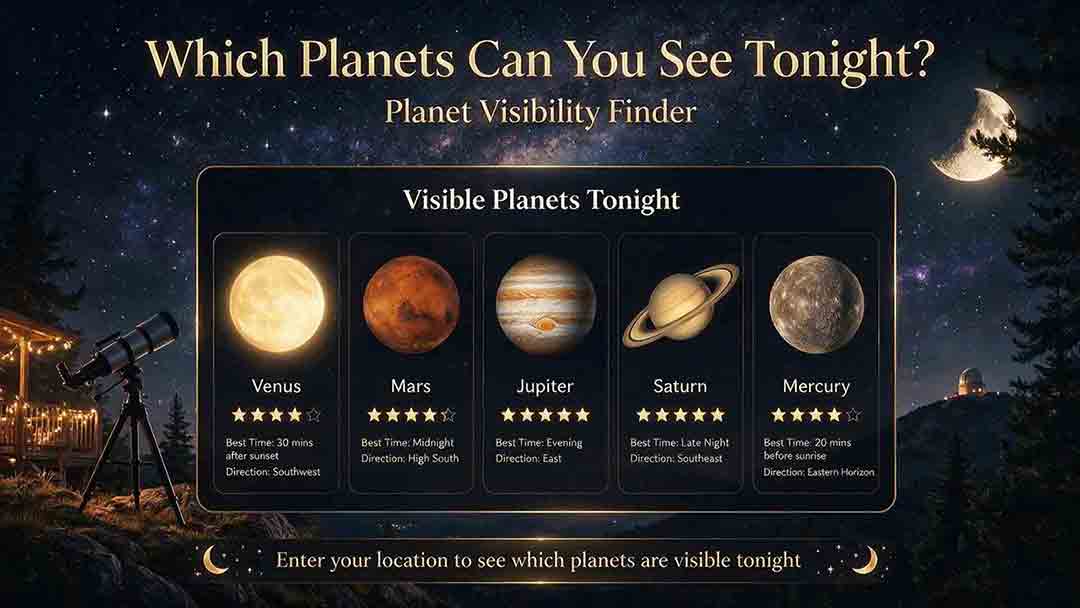
This guide explains how to use a planet visibility finder to decide which planets are realistically observable for a selected date, time, and location. It shows why an object being above the horizon does not guarantee visibility and explains the roles of altitude, azimuth, apparent magnitude, solar elongation, twilight, moonlight, weather, and local obstructions. Readers learn which planets are normally visible without a telescope, how Mercury and Venus differ from the outer planets, and why two finders may produce different results. The article introduces an original Four-Gate Visibility Test covering position, solar light, detectability, and site timing, plus a reproducible Useful Viewing Window calculation. A hypothetical example compares a 1-hour-26-minute naked-eye window with an 18-minute higher-altitude telescope window. Practical troubleshooting, safety guidance, and NASA, USNO, and JPL sources support the planning method.
2025/07/015 min
Astronomical Twilight Calculator: When Does the Sky Become Dark?
Sky & Time Tools

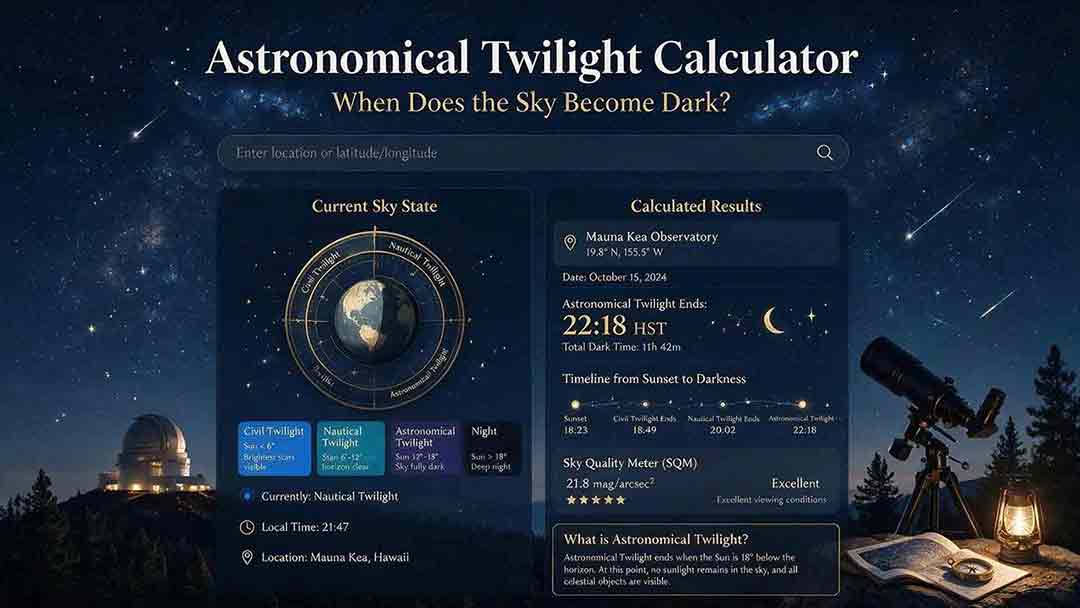
Astronomical Twilight Calculator: When Does the Sky Become Dark?

This guide explains how to use an astronomical twilight calculator to identify the end of evening astronomical twilight and the beginning of morning astronomical twilight for a selected date and location. It distinguishes sunset, civil dusk, nautical dusk, astronomical dusk, and the Sun-below-18° interval while clarifying that solar geometry does not guarantee a visibly dark sky. Readers learn how latitude, season, timezone, daylight-saving rules, moonlight, skyglow, clouds, haze, and high-latitude conditions affect practical planning. The article introduces two original tools: the Darkness Margin, which calculates how much of a session falls inside the Sun-below-18° interval, and a Task Threshold Matrix that matches observing goals to practical twilight stages. A worked cross-midnight example produces a 1-hour-48-minute dark interval. Troubleshooting guidance, planning checks, and authoritative USNO, NOAA, and National Park Service sources support the method.
2025/05/265 min
Moonrise and Moonset Calculator: Plan Your Observation
Sky & Time Tools

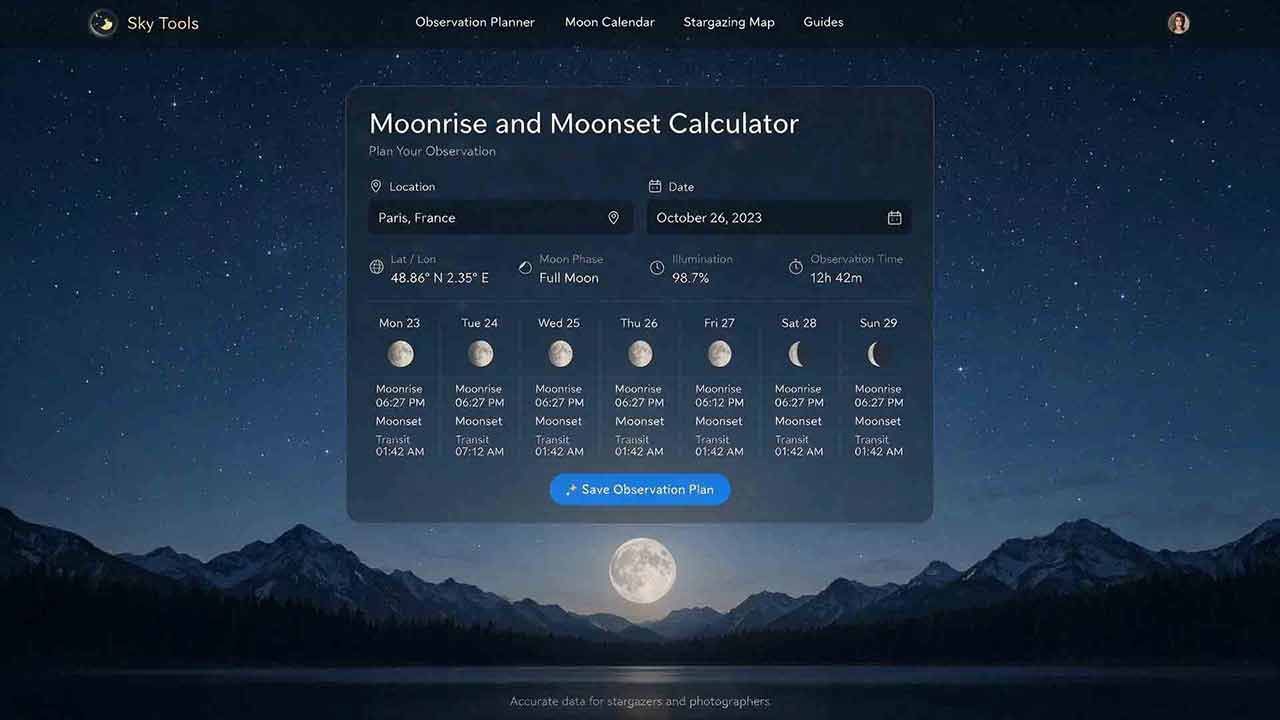
Moonrise and Moonset Calculator: Plan Your Observation

This guide explains how to use a moonrise and moonset calculator to plan lunar observation, astrophotography, meteor watching, and dark-sky sessions. Readers learn how date, coordinates, timezone, daylight-saving rules, observer height, atmospheric refraction, and the local horizon affect predicted event times. It defines moonrise, moonset, upper transit, altitude, azimuth, phase, and illumination, while explaining why a calculated horizon event may not match the first visible appearance of the Moon. The article introduces an original Three-Window Method that compares the sky window, Moon window, and target window, then provides a reproducible overlap calculation and a hypothetical example with a 37-minute fully dark, pre-moonrise interval. Practical tables cover missing rise or set events, high-latitude limitations, common errors, and recommendations for different observers. The guidance is based on NASA and U.S. Naval Observatory documentation.
2025/05/205 min
Moon Phase Calculator: Find the Moon’s Phase for Any Date
Sky & Time Tools

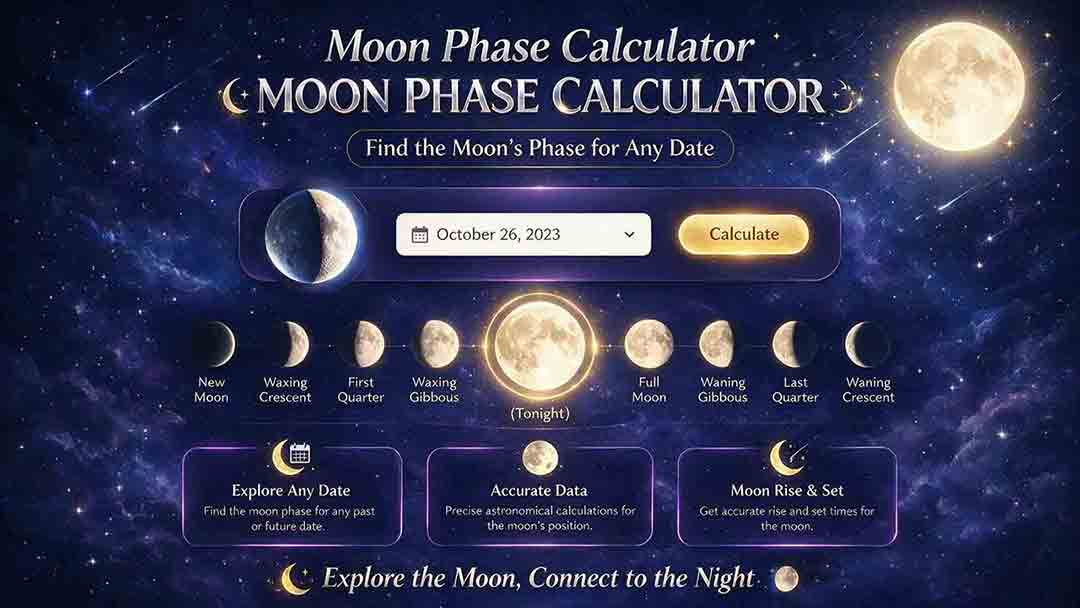
Moon Phase Calculator: Find the Moon’s Phase for Any Date

This guide explains how to use a Moon phase calculator to identify the Moon’s general phase for any selected date and interpret the result accurately. It distinguishes phase labels from illuminated percentage, waxing or waning direction, lunar age, and exact primary-phase times. Readers learn why two calculators may show different labels for the same moment, how timezone conversion can place one Full Moon on different local dates, and why rounded values such as 100% illumination do not necessarily mark the exact Full Moon instant. The article also includes an original comparison showing why equal divisions of a 29.53-day lunar cycle can miss official primary-phase times by several hours. Practical tables help readers apply Moon phase information to lunar observation, crescent photography, meteor showers, deep-sky viewing, and moonlit landscapes. Historical calendar limits, troubleshooting advice, accuracy checks, and authoritative NASA and U.S. Naval Observatory sources are also included.

2025/05/155 min
Space Object Scale Comparison Tool
Space Distance & Scale Tools

Space Object Scale Comparison Tool

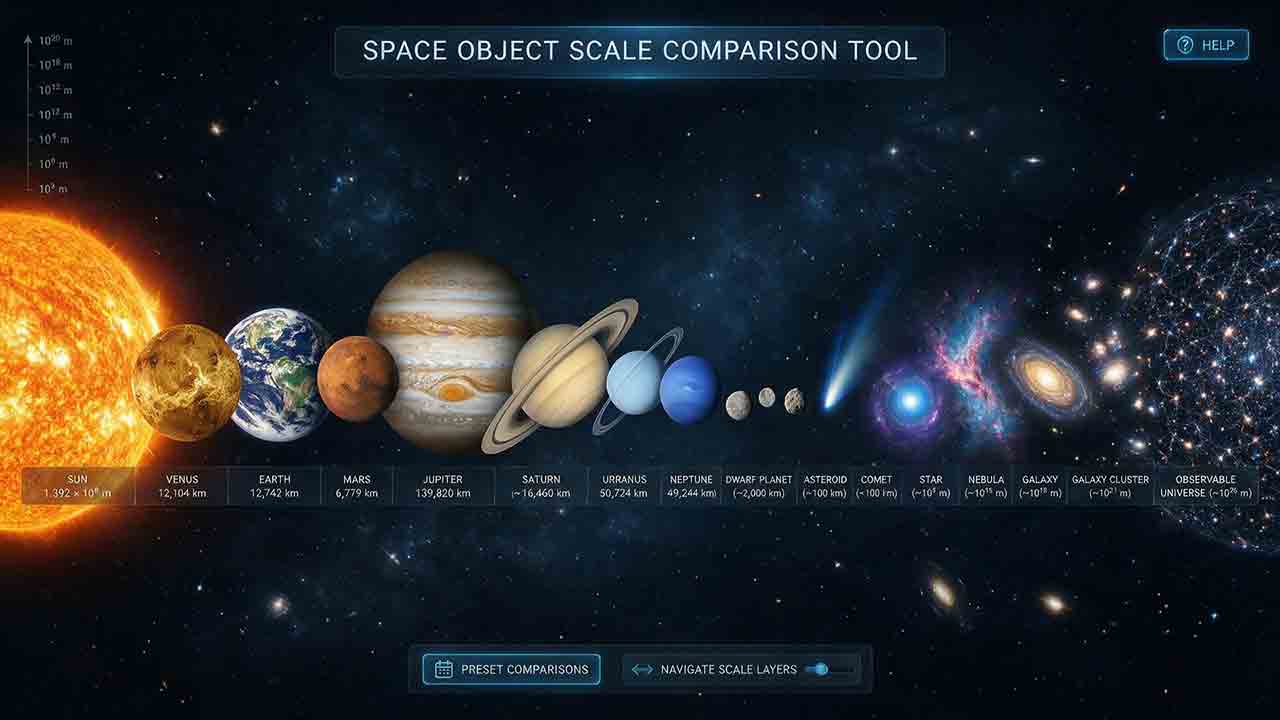
This guide explains how to compare the physical sizes of Bennu, Ceres, Pluto, the Moon, the eight planets, and the Sun on one consistent linear scale. It defines the verified preset objects, distinguishes mean diameter from nominal or approximate width, and shows how to calculate diameter ratios, reference percentages, and scaled model sizes. Original value comes from the Definition–Ratio–Resolution Framework, the Scale-Span Problem, reversible ratio checks, and clear labels for reference-circle area and reference-sphere volume derivations. Worked examples include an Earth-at-10-centimeters model and the visibility limits created by the Sun-to-Bennu size span. The article also explains why rings, comet comae, exoplanets, diffuse nebulae, and black-hole boundaries require custom definitions rather than ordinary planet-diameter presets. Readers gain a practical method for building accurate classroom models, tables, and visualizations without mixing physical size, mass, orbital distance, or angular size.
2025/09/305 min
Planet Weight Calculator
Space Distance & Scale Tools

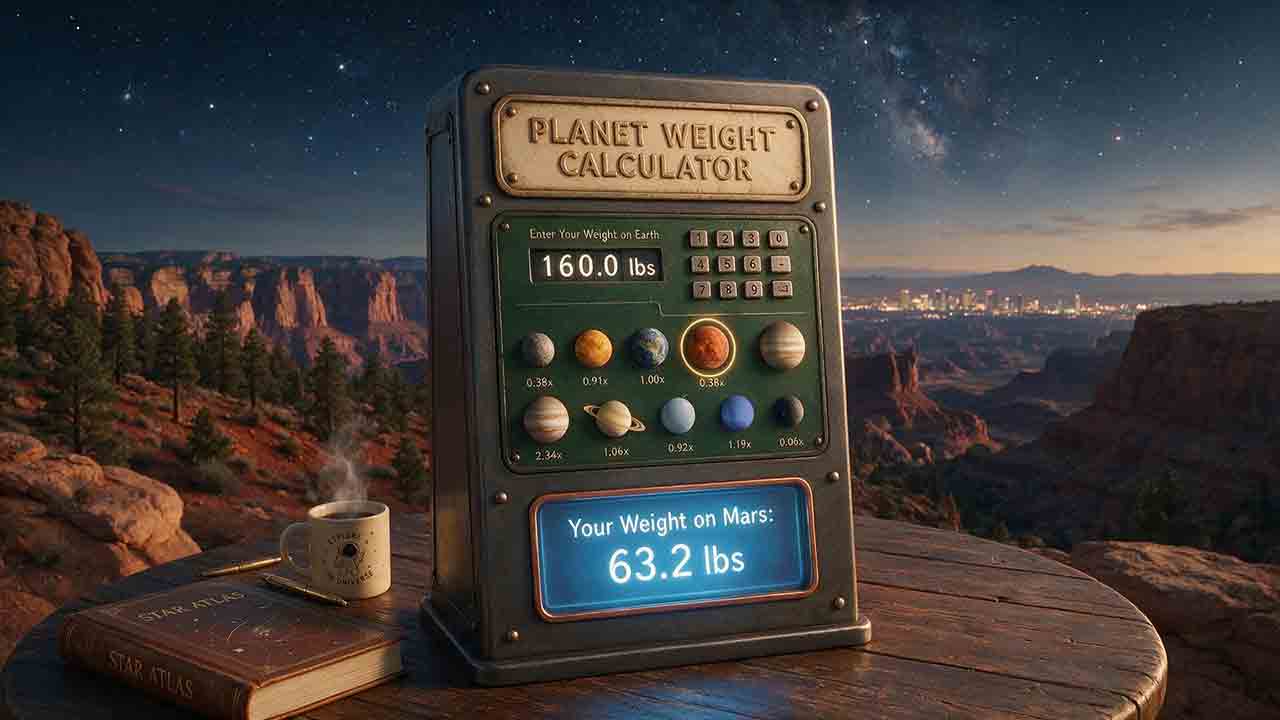
Planet Weight Calculator

This guide explains how a planet weight calculator separates unchanged mass from gravitational force and standard-Earth force equivalents. It shows how to calculate weight with W = mg, interpret kilograms, pound-mass, newtons, pound-force, kg-equivalent, and lb-equivalent, and understand why local scale readings depend on instrument calibration. Sourced gravity presets cover the eight planets, the Moon, and Pluto, with clear warnings for giant planets that have no solid surface. Worked examples, verification values, altitude limits, custom-planet formulas, uncertainty propagation, and the original Reference–Instrument–Support Check help readers evaluate results without confusing force, mass, apparent weight, or reference gravity. The article also explains free fall, reference radii, Pluto data differences, and when a body-specific gravity model is required.

2025/09/215 min