Astrophotography Planning Tools
Explore 5 fascinating articles about astrophotography planning tools
Calculate exposure, field of view, and imaging settings. Essential planning utilities and calculators for astrophotographers.
All Articles (5)
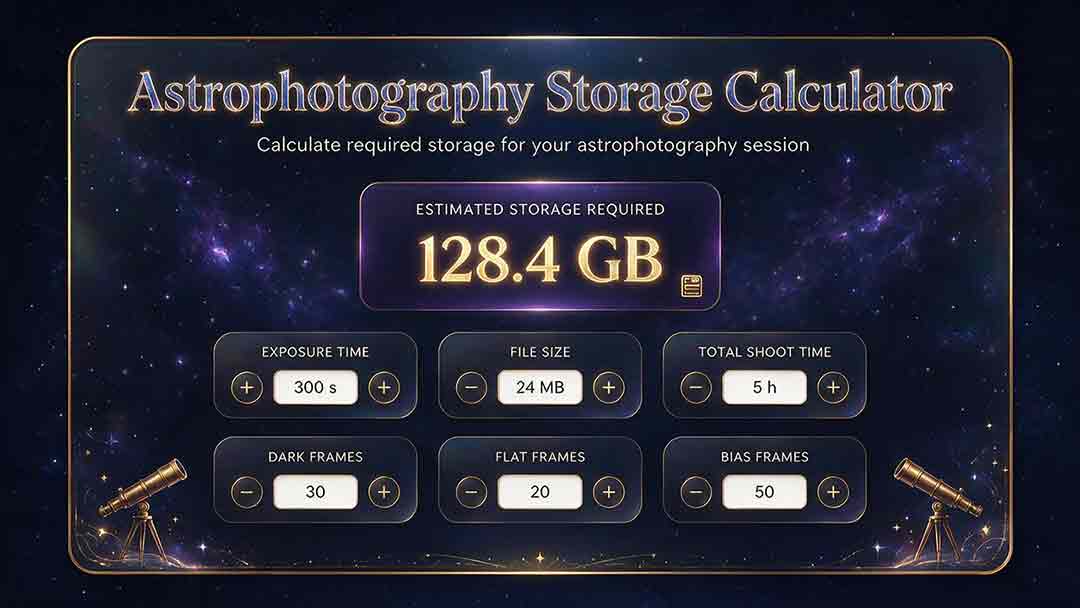
Astrophotography Storage Calculator
This guide explains how to estimate storage for astrophotography capture, processing, and backup without relying on misleading megapixel shortcuts. It compares measured-file, uncompressed-array, and bitrate methods; distinguishes mean, median, high-percentile, and maximum file-size statistics; and explains decimal versus binary storage units. Readers learn how FITS headers, padding, HDUs, RAW compression, calibration frames, RGB conversion, drizzle, mosaics, caches, and temporary files affect project size. Original planning tools include the Four-Bucket Storage Ledger, the Capture–Process–Protect Check, and a clearly defined storage expansion ratio. Worked examples show how to calculate peak logical data, project-relative headroom, complete-copy footprint, media count, write rate, and transfer time. The article also covers integrity verification, backup limitations, retention decisions, and troubleshooting. It is designed to help astrophotographers build realistic capacity plans for single sessions, multi-night projects, planetary video, star trails, and long-term archives.
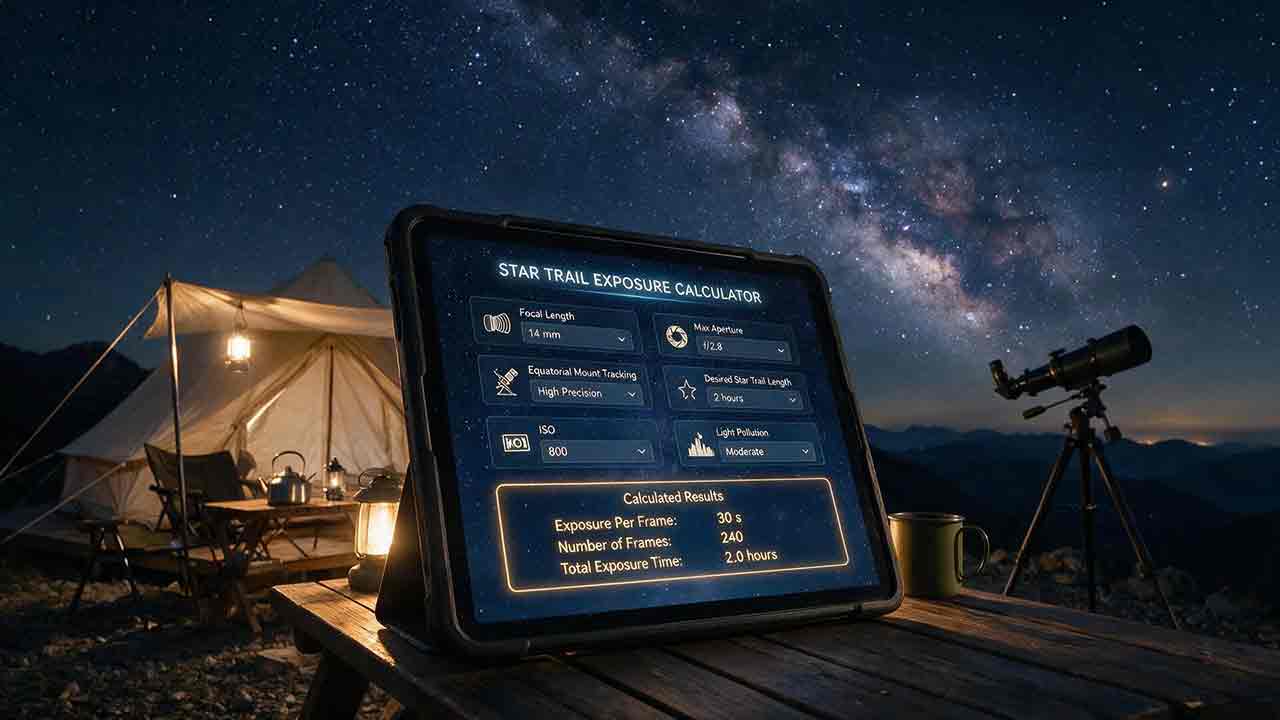
Star Trail Exposure Calculator
This guide explains how to calculate star-trail exposure time from Earth’s sidereal rotation, stellar declination, and local image scale. It distinguishes polar sweep, declination-adjusted sky-path length, projected pixel length, recorded sweep, missing sweep, and the full start-to-end span of a stacked sequence. Original tables compare trail lengths at several declinations, quantify one-second frame gaps at different image scales, and show how recorded time, gap time, duty cycle, and sequence sweep relate. The Trail–Frame–Sequence Check provides a practical framework for separating celestial geometry, per-frame reliability, and sequence continuity. Worked examples also address the celestial-pole edge case, local WCS-based pixel movement, frame-count limits, long-exposure noise reduction, and the difference between a single exposure and stacked frames. Readers can use the article to plan smoother trails, avoid misleading sequence calculations, and verify expected motion with native-resolution test images.
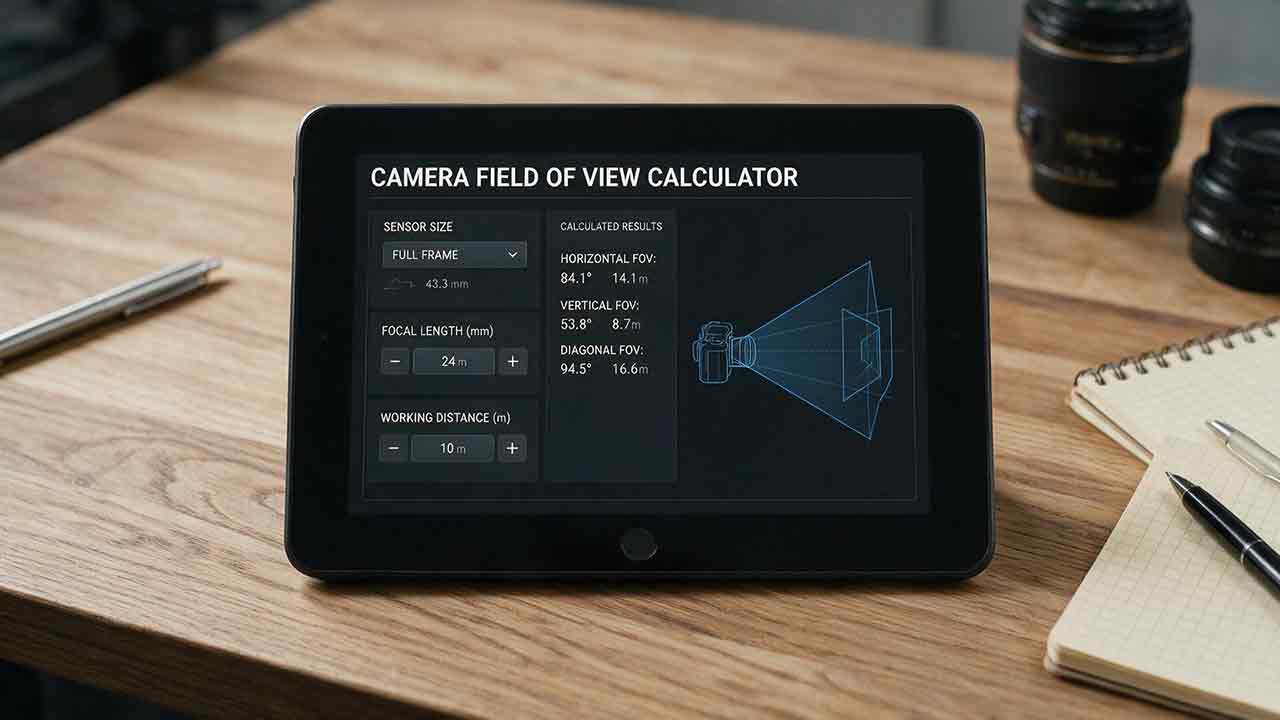
Camera Field of View Calculator
This guide explains how to calculate horizontal, vertical, and diagonal camera field of view from the recorded active sensor dimensions and effective focal length. It distinguishes physical focal length from crop-factor comparisons, shows why aspect ratio and target rotation affect framing, and provides independently calculated reference tables for common sensor sizes and focal lengths. The original Frame Envelope Check separates ideal frame geometry, the target envelope, and the usable frame retained after dithering, registration, distortion correction, and cropping. Worked examples demonstrate target occupancy, maximum permitted focal length, rotated bounding boxes, and mosaic panel counts with overlap. The article also explains radians versus degrees, crop and stabilization modes, focus breathing, rectilinear versus fisheye projection, and plate-solving verification through a celestial WCS. Readers can use the formulas, margin budget, troubleshooting table, and framing checklist to plan wide-field compositions, small-target imaging, or mosaics without treating a mathematical edge-to-edge fit as a guaranteed final frame.
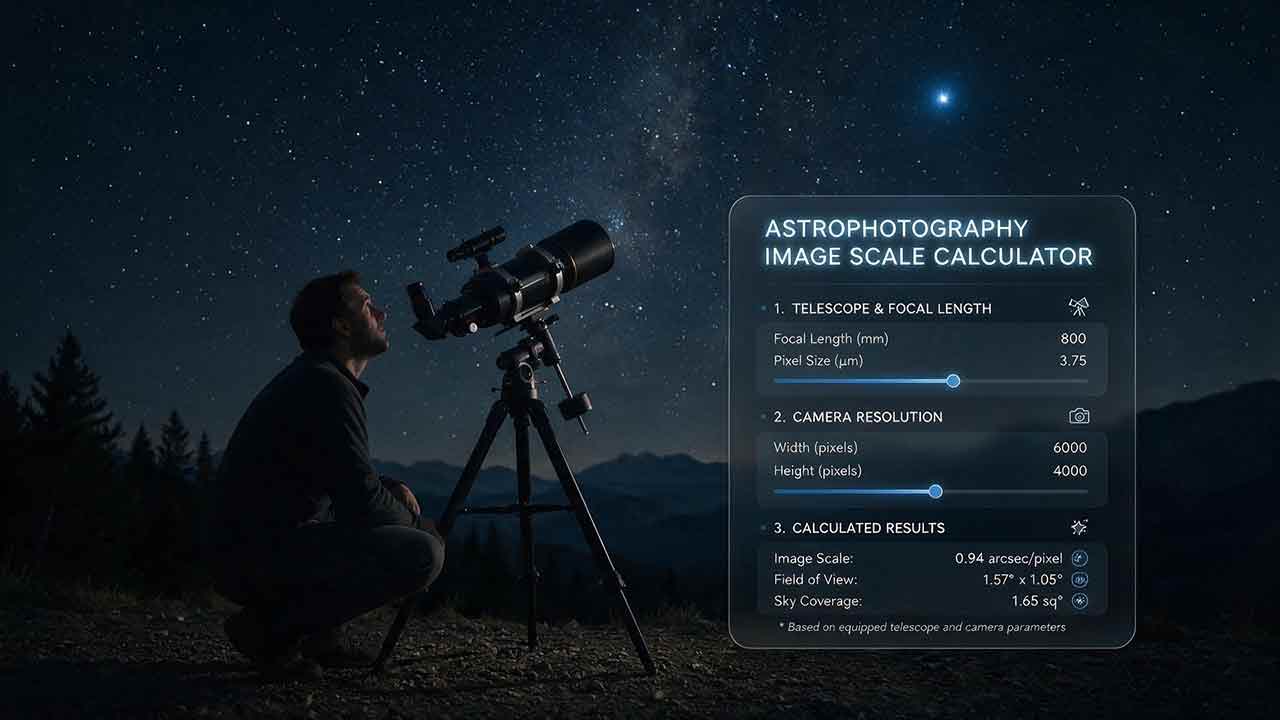
Astrophotography Image Scale Calculator
This guide explains how to calculate astrophotography image scale from camera pixel size and effective focal length, then interpret the result without confusing detector sampling with true optical resolution. It covers correct inputs, non-square pixels, reducers, amplifiers, binning, resampling, field of view, plate scale terminology, and WCS-based verification. Two original reference tables compare image scale across common pixel pitches and focal lengths and show how delivered stellar FWHM translates into pixels per FWHM. The original Scale–Quality–Target Check provides a practical decision framework for matching sampling to real image quality and target detail. Reproducible guidance explains how to measure representative FWHM from native-resolution data, diagnose discrepancies between calculated and plate-solved scale, and derive a local effective focal length. The article also distinguishes wide-field, small-target, lunar, planetary, photometric, and astrometric use cases while avoiding universal purchasing claims or unsupported equipment-testing conclusions.
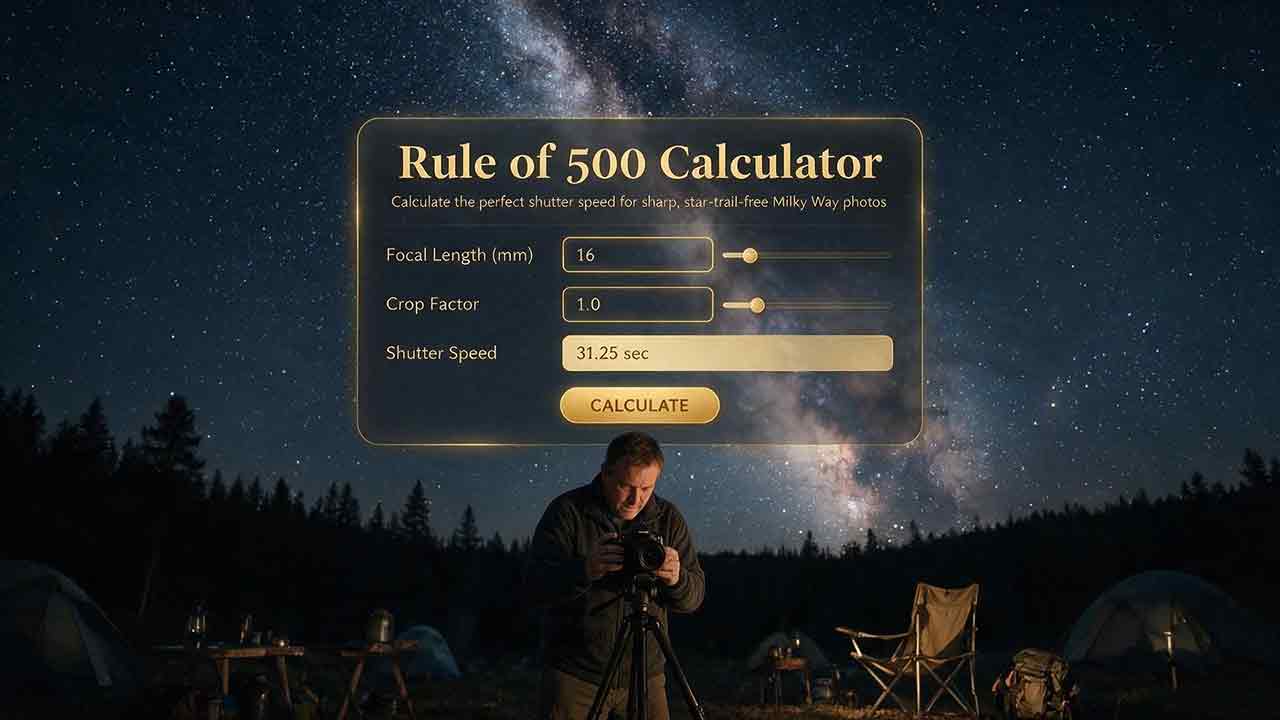
Rule of 500 Calculator for Milky Way Photography
This guide explains how to use the Rule of 500 Calculator to estimate a starting shutter speed for untracked Milky Way photography. It shows how actual focal length and crop factor affect the calculation, why crop factor must not be applied twice, and how the Rule of 400 and Rule of 300 provide shorter alternatives. Original comparison tables quantify exposure times across common focal lengths and sensor formats, while a light-loss table shows the practical signal cost of shortening an exposure. The guide also introduces the Three-Limit Check, an original motion–optics–signal diagnostic framework for separating star movement from focus, lens, and noise problems. Calculation-based examples, rounding rules, input limits, troubleshooting guidance, and a field checklist help readers choose a camera-supported setting and verify it in a magnified test frame. The article relies on astronomy references, manufacturer documentation, and transparent calculations rather than claimed field tests of a specific camera or lens.