Light-Travel Time Calculator

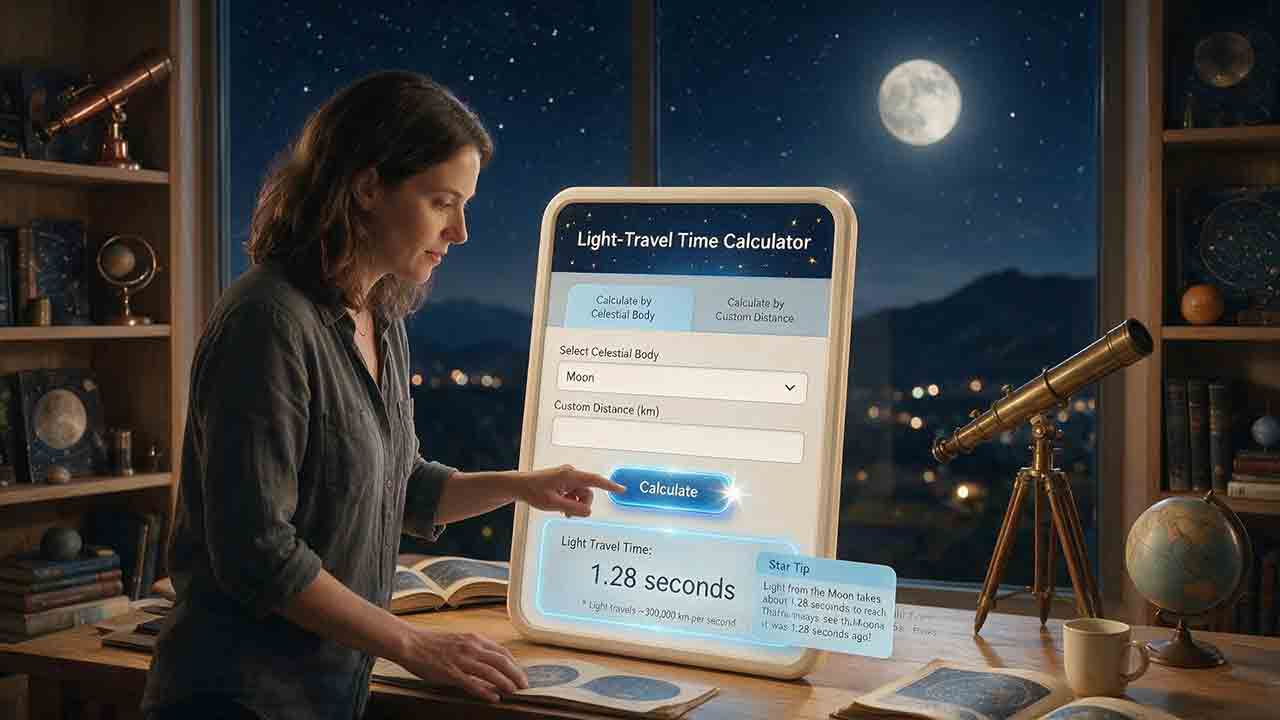
Light-Travel Time Calculator
A light-travel time calculator converts a known distance into the minimum time light or a radio signal needs to cross that path in vacuum. Enter the distance, select its unit, and choose one-way or round-trip time. The calculation uses $t=d/c$, where $c$ is exactly 299,792,458 m/s. The result is propagation time—not spacecraft flight time or total communications latency.
Key Takeaways
- Light and radio signals in vacuum travel at exactly 299,792,458 meters per second.
- One-way light time is calculated with $t=d/c$; a simplified round trip uses $2d/c$.
- The distance must match the actual observer, target, signal direction, and time.
- A calculator provides the physical propagation floor, not processing, routing, scheduling, or mission-operation delays.
- Ordinary distance conversion is straightforward, but moving-target navigation and cosmological distances require additional modeling.
This guide explains how to choose the right distance, interpret one-way and round-trip results, verify the calculator independently, and identify cases in which a simple distance-divided-by-light-speed calculation is not enough.
Calculation standard: All values are normalized to meters and divided by the exact SI value $c=299{,}792{,}458\ \text{m/s}$. Intermediate values are not rounded. Displayed results are rounded according to the input precision and intended use. One Julian year is treated as 31,557,600 seconds, one international mile as exactly 1,609.344 meters, and one astronomical unit as exactly 149,597,870,700 meters.
How Do You Use the Light-Travel Time Calculator?
A reliable result starts by answering three questions:
- Path: Where does the signal start and end?
- Clock: Do you need observation, command, or round-trip time?
- Epoch: At what date and time does the distance apply?
Once those are clear, the arithmetic is simple.
Step 1: Identify Both Ends of the Signal Path
Enter the distance between the signal’s departure point and arrival point.
Examples include:
- Earth to a spacecraft
- a ground station to the Moon
- Earth to Mars
- the Sun to Earth
- a telescope to a star
- one spacecraft to another
Do not use a planet’s distance from the Sun when the question concerns communication between Earth and that planet. Those measurements describe different paths.
Step 2: Enter a Valid Distance
The distance should be finite and non-negative.
A distance of zero produces zero propagation time. A negative value does not represent a physical path length and should not be interpreted as a valid light-time result.
Scientific notation can be useful for very large distances, but the entered unit must still match the value.
Step 3: Select the Input Unit
Choose the unit attached to the source value. The conversions covered by this guide include:
- meters
- kilometers
- international miles
- astronomical units
- light-seconds
- light-minutes
- light-hours
- light-years
- parsecs
Entering the original value directly is usually safer than converting it manually first. Every extra conversion creates another opportunity for a unit error or premature rounding.
Step 4: Choose One-Way or Round-Trip Time
Choose one-way when calculating:
- how long ago observed light left a target
- how long an outgoing command takes to arrive
- the minimum delay before a remote system can receive information
Choose round-trip when estimating the minimum time required for a signal to travel outward and for a response to return.
A basic round-trip calculation assumes an immediate response and equal outward and return path lengths. That is useful for estimates, but it is not always valid for moving targets.
Step 5: Read the Result in a Useful Format
A result such as 49,900 seconds is mathematically clear but not immediately intuitive. The same interval is easier to understand as approximately 13 hours, 51 minutes, and 40 seconds.
For technical work, retain both:
- a decimal value for calculations
- a days-hours-minutes-seconds value for interpretation
Step 6: Check the Distance Reference
Before relying on the result, confirm:
- the observer
- the target
- the date and time
- whether the value is center-to-center, surface-to-surface, or station-to-spacecraft
- whether it is an instantaneous range, an orbital average, or a rounded teaching value
A precisely calculated answer can still be physically irrelevant when the wrong distance was entered.
How Is Light-Travel Time Calculated?
The one-way formula is:
$$
t=\frac{d}{c}
$$
where:
- $t$ is the one-way propagation time
- $d$ is the path distance
- $c$ is the speed of light in vacuum
The Bureau International des Poids et Mesures definition of the metre fixes:
$$
c=299{,}792{,}458\ \text{m/s}
$$
This numerical value is exact in the International System of Units. In an ordinary light-time calculation, uncertainty comes from the input distance, path definition, timing, or reference frame—not from uncertainty in $c$.
How Is Simplified Round-Trip Time Calculated?
When the outward and return paths can be treated as equal:
$$
t_{\text{round trip}}=\frac{2d}{c}
$$
For moving endpoints, the more accurate relationship is:
$$
t_{\text{round trip}}
t_{\text{outgoing}}
+
t_{\text{returning}}
$$
The return signal begins later, when the target and observer may occupy different positions.
Which Unit Definitions Are Used?
Each distance is converted to meters before light time is calculated.
| Input unit | Conversion used | Treatment |
|---|---|---|
| meter | $1\ \text{m}$ | Exact |
| kilometer | $1{,}000\ \text{m}$ | Exact |
| international mile | $1{,}609.344\ \text{m}$ | Exact |
| astronomical unit | $149{,}597{,}870{,}700\ \text{m}$ | Exact |
| light-second | $299{,}792{,}458\ \text{m}$ | Exact |
| light-minute | $17{,}987{,}547{,}480\ \text{m}$ | Exact |
| light-hour | $1{,}079{,}252{,}848{,}800\ \text{m}$ | Exact |
| light-year | $9{,}460{,}730{,}472{,}580{,}800\ \text{m}$ | Exact under the Julian-year convention |
| parsec | approximately $3.085677581491367\times10^{16}\ \text{m}$ | Derived astronomical conversion; decimal SI value is approximate |
The international-mile conversion follows the NIST Guide to the SI.
The International Astronomical Union’s 2012 Resolution B2 defines:
$$
1\ \text{au}
149{,}597{,}870{,}700\ \text{m}
$$
Under the Julian-year convention:
$$
1\ \text{Julian year}
365.25\ \text{days}
31{,}557{,}600\ \text{s}
$$
Therefore:
$$
1\ \text{light-year}
c\times31{,}557{,}600\ \text{s}
$$
$$
1\ \text{light-year}
9{,}460{,}730{,}472{,}580{,}800\ \text{m}
$$
How Is a Parsec Converted?
A parsec is associated with stellar parallax. NASA describes it as the distance at which a baseline of one astronomical unit corresponds to a parallax angle of one arcsecond.
Using that geometric relationship, this calculator adopts:
$$
1\ \text{pc}
\frac{648{,}000}{\pi}\ \text{au}
$$
Together with the exact AU value, this produces:
$$
1\ \text{pc}
\approx
3.085677581491367\times10^{16}\ \text{m}
$$
and:
$$
1\ \text{pc}
\approx
3.261563777\ \text{light-years}
$$
These decimal values are calculated from the stated conventions and rounded for display. NIST publishes a rounded reference conversion of approximately $3.085678\times10^{16}$ meters per parsec, while NASA’s cosmic-distance reference gives the familiar value of about 3.26 light-years.
Which Values Can Verify the Calculator?
The following values are intended for implementation testing.
| Test input | Expected one-way result |
|---|---|
| 1 kilometer | $3.335640951982$ microseconds |
| 1 international mile | $5.368193752226$ microseconds |
| 1 astronomical unit | $499.004783836156$ seconds |
| 1 light-second | exactly 1 second |
| 1 light-minute | exactly 60 seconds |
| 1 light-hour | exactly 3,600 seconds |
| 1 light-year | exactly 31,557,600 seconds |
| 1 parsec | approximately $3.261563777167$ Julian years |
These extended values are for checking calculation logic, not recommended user-facing precision. Intermediate calculations should not be rounded, but displayed results should reflect the precision of the entered distance.
Useful Identity Tests
A correct implementation should preserve these relationships within its displayed precision:
$$
1\ \text{light-second}
\rightarrow
1\ \text{second}
$$
$$
1\ \text{light-minute}
\rightarrow
60\ \text{seconds}
$$
$$
1\ \text{light-hour}
\rightarrow
3{,}600\ \text{seconds}
$$
$$
1\ \text{light-year}
\rightarrow
31{,}557{,}600\ \text{seconds}
$$
These cases help detect accidental double conversion of light-based units.
Which Light-Time Result Do You Actually Need?
“Light-travel time” can describe three different clocks.
| Clock | Question answered | Signal direction | Typical use |
|---|---|---|---|
| Observation clock | How long ago did the observed light leave the target? | Target to observer | Astronomy and imaging |
| Command clock | How long before an outgoing instruction reaches the target? | Observer to target | Spacecraft operations |
| Conversation clock | What is the minimum request-and-reply delay? | Outward and return | Communications planning |
Observation Clock
A telescope does not show a distant object in real time. It shows the object when the received light departed.
If the incoming light time is 12 minutes, the observation represents the target approximately 12 minutes earlier.
Command Clock
A command cannot affect a remote spacecraft until the outgoing signal reaches it.
If the command light time is 40 minutes, no newly transmitted instruction can arrive sooner than 40 minutes after transmission.
Conversation Clock
An interactive exchange requires an outward message and an inward response.
At a one-way delay of 20 minutes, the idealized send-and-reply propagation floor is approximately 40 minutes. Real operations take longer because the command must be received, validated, executed, recorded, scheduled, and transmitted back.
This three-clock framework prevents a correct numerical result from being attached to the wrong practical question.
How Do You Choose the Correct Distance?
Use a distance that corresponds to the actual signal path and intended level of accuracy.
Distance-Source Ladder
| Distance source | Best use | Main limitation |
|---|---|---|
| Rounded representative value | Demonstrations and scale comparisons | Not time-specific |
| Mean orbital distance | Comparing orbit sizes | Not observer-to-target range |
| Date-specific observer range | Observation and communication estimates | Depends on observer and timestamp |
| Light-time-corrected ephemeris output | Precision astronomical work | Requires correct ephemeris settings |
| Validated mission navigation solution | Spacecraft operations | Requires specialist systems and procedures |
Why Do Date and Observer Matter?
Planets, moons, asteroids, comets, spacecraft, and observatories are all moving.
A single permanent “distance to Mars” cannot describe every date. Mars’s average distance from the Sun also does not equal the Earth–Mars range.
The observer matters as well. A range measured from Earth’s center differs from a range measured from a ground station on Earth’s rotating surface. The difference may be unimportant for a classroom example but relevant for precision timing.
Use a rounded distance when the goal is to understand scale. Use a date-specific observer range when the result is intended to describe a real object at a particular time.
How Can JPL Horizons Provide a Date-Specific Range?
The official JPL Horizons System Manual documents observer tables that can provide observer range and one-way down-leg light time.
A practical workflow is:
- Open the JPL Horizons web application.
- Select Observer Table as the ephemeris type.
- Choose the planet, moon, asteroid, comet, or spacecraft.
- Define the observer, such as Earth’s center or a particular observing site.
- Enter the required date and time.
- Request Observer range & range-rate or One-way down-leg light-time.
- Generate the ephemeris.
- Check the output units, observer location, and time scale.
In a Horizons observer table, one-way down-leg light-time is the elapsed time since the observed light left or reflected from the target and reached the observer at the listed time.
That makes it an incoming observation-clock quantity. It should not automatically be treated as an outgoing command time in precision work.
Worked Example 1: Earth–Moon Light Time
Use a rounded representative Earth–Moon distance of 384,400 km.
$$
t
\frac{384{,}400\ \text{km}}
{299{,}792.458\ \text{km/s}}
$$
$$
t
\approx
1.2822\ \text{s}
$$
The one-way light time is approximately 1.28 seconds.
Under the simplified equal-path assumption:
$$
t_{\text{round trip}}
\approx
2.5644\ \text{s}
$$
The round-trip light time is therefore approximately 2.56 seconds.
This is an illustrative value, not a live lunar range. The actual Earth–Moon distance changes continuously, and a surface observer is not located at Earth’s center.
Worked Example 2: Light Traveling One Astronomical Unit
Using the exact AU definition:
$$
1\ \text{au}
149{,}597{,}870{,}700\ \text{m}
$$
$$
t
\frac{149{,}597{,}870{,}700}
{299{,}792{,}458}
$$
$$
t
\approx
499.004783836\ \text{s}
$$
That is:
$$
8\ \text{minutes}\ 19.004783836\ \text{seconds}
$$
Because both the AU and $c$ are exact under the stated definitions, retaining additional digits is appropriate in this unit-conversion example.
Light takes approximately 8 minutes and 19 seconds to travel exactly 1 AU in vacuum.
Earth’s instantaneous distance from the Sun varies during its orbit, so the current Sun–Earth light time is not always exactly the 1 AU value.
Worked Example 3: A Hypothetical Earth–Mars Range
Suppose an ephemeris gives an Earth-to-Mars range of 225,000,000 km for a particular observer and time.
$$
t
\frac{225{,}000{,}000}
{299{,}792.458}
$$
$$
t
\approx
750.519\ \text{s}
$$
This is approximately:
$$
12\ \text{minutes}\ 30.519\ \text{seconds}
$$
Under the simplified equal-path assumption:
$$
t_{\text{round trip}}
\approx
1501.038\ \text{s}
$$
or approximately:
$$
25\ \text{minutes}\ 1.038\ \text{seconds}
$$
The result does not mean a rover task will be completed in 25 minutes. It excludes command validation, onboard processing, activity duration, communication scheduling, data packaging, and transmission availability.
Worked Example 4: A Star at 4.24 Light-Years
Suppose a catalog lists a star at 4.24 light-years.
Because a light-year is the distance light travels in one Julian year, the nominal incoming light time is:
$$
4.24\ \text{Julian years}
$$
No conversion into kilometers is necessary unless the physical distance is also required.
The observation shows the star approximately 4.24 years before the light reached the observer. The reliability of that statement depends on the uncertainty and interpretation of the catalog distance.
How Far Does Light Travel in a Given Time?
The values below follow directly from the exact SI speed of light.
| Travel time | Distance in vacuum | Informal scale comparison |
|---|---|---|
| 1 microsecond | 299.792458 m | Several hundred meters |
| 1 millisecond | 299.792458 km | Hundreds of kilometers |
| 10 milliseconds | 2,997.92458 km | Thousands of kilometers |
| 1 second | 299,792.458 km | About 78% of a representative 384,400 km Earth–Moon distance |
| 1 minute | 17,987,547.48 km | Inner-solar-system scale |
| 1 hour | 1,079,252,848.8 km | Planetary-system scale |
| 1 day | 25,902,068,371.2 km | Outer-solar-system scale |
| 1 Julian year | 9,460,730,472,580.8 km | One light-year |
The first three comparisons are orientation aids rather than standardized geographic categories. The Earth–Moon comparison uses a rounded representative distance; the actual lunar range varies continuously.
Which Output Unit Is Easiest to Read?
The clearest display depends on the result’s size.
These boundaries are editorial recommendations rather than scientific definitions.
| Calculated time | Recommended display |
|---|---|
| Less than 1 millisecond | Microseconds or nanoseconds |
| 1 millisecond to less than 1 second | Milliseconds |
| 1 second to less than 1 minute | Seconds |
| 1 minute to less than 1 hour | Minutes and seconds |
| 1 hour to less than 1 day | Hours and minutes |
| 1 day to less than 1 year | Days, hours, and minutes |
| 1 year or more | Years, with an optional decimal value |
When precision matters, show both a decimal value and a readable value.
For example:
- Decimal result: 12.50865 minutes
- Readable result: 12 minutes, 30.519 seconds
Does Reflected Light Have More Than One Travel Leg?
Yes. Reflected sunlight usually has at least two distinct legs:
- sunlight travels from the Sun to the reflecting object
- reflected light travels from the object to the observer
The object-to-observer leg answers:
When did the observed photon leave the object?
The combined Sun-to-object and object-to-observer path answers:
Approximately how long has the photon been traveling since it left the Sun?
Those are different questions.
An observer may see a planet as it appeared several minutes ago, while the sunlight illuminating that scene left the Sun earlier still. A single Earth-to-planet distance does not describe the photon’s complete path.
This distinction is useful when interpreting:
- planetary images
- illumination changes
- reflected-light observations
- eclipse geometry
- solar-system diagrams
Is One-Way Light Time the Same in Both Directions?
Not necessarily.
For stationary endpoints in a simplified model, the outward and return distances are equal. Doubling one-way time is then appropriate.
For moving endpoints, the return signal begins later and from a different position. The observer may also move before the signal arrives.
For high-precision work, the relevant quantity is not always the simultaneous straight-line separation of two objects at one timestamp. Navigation systems solve for the signal path between transmission and reception events.
For an incoming reception case, a simplified implicit relationship is:
$$
\mathrm{LT}
\frac{
\left|
\mathbf{T}(t-\mathrm{LT})-\mathbf{O}(t)
\right|
}{c}
$$
where:
- $\mathbf{T}$ is the target position
- $\mathbf{O}$ is the observer position
- $t-\mathrm{LT}$ is the time when the received signal left the target
An outgoing transmission calculation instead requires the target’s position when the signal arrives.
The JPL NAIF SPICE documentation on aberration corrections distinguishes reception and transmission corrections for this reason.
For classroom work, the difference may be negligible. For spacecraft navigation, radar ranging, or precise pointing, it can be essential.
How Accurate Is a Light-Time Result?
The arithmetic can be precise while the physical result remains uncertain.
Accuracy depends on:
- the distance source
- the observer and target definitions
- the timestamp
- the reference frame
- the signal direction
- endpoint motion
- the modeled path
Match Output Precision to Input Precision
Do not report more meaningful digits than the distance supports.
The verification value for exactly 1 AU may legitimately contain many digits because the AU and $c$ are exact under the stated definitions.
A rounded Earth–Moon distance of 384,400 km does not justify reporting a physical result to nine decimal places.
How Does Distance Error Affect Time Error?
Because:
$$
t=\frac{d}{c}
$$
a distance uncertainty $\Delta d$ produces a time uncertainty:
$$
\Delta t=\frac{\Delta d}{c}
$$
Useful mental checks are:
- approximately 300 meters corresponds to 1 microsecond
- approximately 300 kilometers corresponds to 1 millisecond
- approximately 300,000 kilometers corresponds to 1 second
These rounded relationships are useful for detecting misplaced decimal points and unit errors.
What If the Signal Is Relayed?
If a signal passes through multiple stations or spacecraft, calculate each path separately:
$$
t_{\text{total}}
\frac{d_1}{c}
+
\frac{d_2}{c}
+
\cdots
+
\frac{d_n}{c}
$$
A direct endpoint-to-endpoint distance is not sufficient when the real signal follows a longer relay path.
Arithmetic Precision Is Not Physical Relevance
A result can be mathematically correct to many decimal places but physically unsuitable because it uses:
- an orbital average instead of a current range
- the wrong observer
- the wrong signal direction
- a center-to-center distance for a surface path
- a static distance for a moving-target calculation
Check the meaning of the input before increasing the number of displayed digits.
When Is a Basic Calculator Enough?
| Situation | Is $d/c$ sufficient? | Recommended approach |
|---|---|---|
| Converting a textbook distance | Yes | Use the stated distance |
| Comparing astronomical scales | Yes | Use consistent unit definitions |
| Estimating one-way vacuum delay | Usually | Use a current range when available |
| Estimating a rough round trip | Usually | Double only when endpoint motion is negligible |
| Interpreting a telescope observation | Usually | Use incoming one-way light time |
| Planning spacecraft commands | Not by itself | Use validated ephemerides and mission procedures |
| Radar-ranging analysis | No | Use tracking, timing, and relativistic models |
| Precision spacecraft pointing | No | Apply reception or transmission corrections |
| Converting a nearby stellar distance | Usually | Include measurement uncertainty |
| Interpreting a high-redshift galaxy distance | Potentially misleading | Use a cosmological model |
A basic calculator is strongest when treated as a transparent conversion tool, not as a complete navigation or communications simulator.
Is Light Time the Same as Spacecraft Travel Time?
No. Light time and spacecraft flight time are different physical quantities.
| Quantity | Main controlling factors | Can $d/c$ calculate it? |
|---|---|---|
| Light-travel time | Path distance and $c$ | Yes |
| Vacuum radio propagation time | Path distance and $c$ | Usually |
| Spacecraft flight time | Trajectory, propulsion, gravity, velocity, launch window | No |
| Human mission duration | Vehicle, orbit design, operations, safety constraints | No |
| End-to-end data delivery | Propagation, coding, routing, scheduling, processing | Only the propagation component |
A spacecraft does not cross a distance at the speed of light. Objects with mass cannot be accelerated to $c$, and interplanetary flight paths are governed by orbital mechanics rather than a simple straight-line distance.
What Does the Basic Result Include?
| Included | Not included |
|---|---|
| Unit normalization | Processing and operational delays |
| Vacuum light-speed conversion | Ground-station and routing delays |
| One-way propagation time | Media-specific propagation |
| Simplified round-trip time | Moving-target navigation corrections |
| Readable time conversion | Relativistic or gravitational corrections |
| Static path calculation | Ephemeris uncertainty or cosmological expansion |
The result is best described as a vacuum propagation baseline.
It should not be labeled “total communications delay” unless the other relevant delay components have also been modeled.
Does Light Always Travel at the Calculator’s Speed?
The calculator uses the speed of light in vacuum.
Electromagnetic signals generally propagate more slowly through materials such as:
- glass
- optical fiber
- water
- dielectric components
- parts of Earth’s atmosphere
For a known propagation speed $v$, a simple estimate is:
$$
t=\frac{d}{v}
$$
However, some media are dispersive, meaning that propagation behavior depends on frequency. For pulses and data transmission, the relevant engineering quantity may be group velocity, not a single phase-velocity value.
Group velocity can depend on:
- frequency
- wavelength
- refractive index
- material composition
- temperature
- waveguide or fiber design
The simple $d/v$ model is therefore an estimate unless the path and propagation properties are known. MIT OpenCourseWare provides an academic introduction to phase velocity, group velocity, and dispersive media.
A vacuum light-time result should not be used as a precision prediction for a fiber-optic route or electronic communications system.
Why Does $d/c$ Need Care for Distant Galaxies?
For ordinary solar-system and nearby stellar conversions, dividing distance by light speed is useful.
At cosmological scales, “distance” can refer to several different quantities:
- lookback time
- comoving distance
- proper distance
- luminosity distance
- angular-diameter distance
- light-travel distance
These quantities are not interchangeable.
The universe expands while light travels. As explained in NASA’s overview of cosmological redshift, cosmic expansion stretches light traveling from distant galaxies.
A galaxy described as “10 billion light-years away” does not necessarily have a lookback time of exactly 10 billion years. The interpretation depends on:
- the distance definition
- the measured redshift
- the assumed cosmological parameters
- the history of cosmic expansion
For high-redshift objects, use a cosmology calculator that states its model parameters rather than treating every published distance as a static path length.
What Causes Unexpected Results?
| Unexpected result | Likely cause | Correction |
|---|---|---|
| Answer is 1,000 times too large or small | Meters and kilometers were mixed | Match the distance and light-speed units |
| Answer is twice the expected value | Round-trip mode was selected | Use one-way mode |
| Planet result differs from another source | Different observer, date, or time | Compare ephemeris settings |
| Planetary delay appears permanently fixed | An orbital average was used | Obtain a date-specific range |
| Mars delay was calculated from Mars–Sun distance | Wrong path endpoints | Use Earth-to-Mars range |
| Result contains unsupported decimals | Input precision was overstated | Round to appropriate significant figures |
| A light-year input returns the same number of years | The unit already encodes light travel | This is expected |
| Real data delivery takes longer | Operational delays were omitted | Add processing, routing, and scheduling |
| Fiber delay is underestimated | Vacuum speed was used | Use a path-specific group delay |
| Galaxy distance conflicts with lookback time | Cosmological distance types were mixed | Use a cosmological model |
| A precise round trip differs from $2d/c$ | Endpoints moved during the exchange | Calculate the two legs separately |
Light-Time Result Audit Checklist
Before publishing or relying on a result, confirm:
- The observer and target are identified.
- The distance applies to the intended date and time.
- The input unit matches the source.
- One-way or round-trip mode matches the question.
- The result is labeled as propagation time.
- Displayed precision matches the distance quality.
- Specialized effects are acknowledged when relevant.
This checklist prevents more practical errors than adding extra decimal places.
Practical Conclusion
Use the light-travel time calculator when you have a distance and need its corresponding vacuum propagation time. For a fixed educational example, enter the distance and apply $t=d/c$. For a real planet, moon, asteroid, or spacecraft, obtain a date-specific observer range first.
Students can use representative distances, observers usually need incoming one-way light time, and communications planners should separate command delay from complete operational response time. Precision navigation, radar analysis, engineering systems, and high-redshift cosmology require specialist models beyond a general-purpose converter.
Scope notice: This calculator is intended for education, estimation, and general reference. Precision navigation, mission operations, engineering systems, and safety-critical timing require validated specialist tools and procedures.
Related Space Distance and Scale Tools
- Space Distance Converter — convert between common terrestrial and astronomical distance units.
- Astronomical Unit Converter — convert AU into kilometers, miles, light time, and related units.
- Light-Year Converter — convert light-years into parsecs, AU, kilometers, and miles.
- Planet Distance Calculator — calculate or compare date-specific planetary distances.
- Solar System Scale Calculator — turn astronomical distances into understandable scale models.
Frequently Asked Questions
How Long Does Light Take to Travel 1 Kilometer?
In vacuum:
$$
t
\frac{1{,}000}
{299{,}792{,}458}
$$
$$
t
\approx
3.335640952\ \text{microseconds}
$$
This is a vacuum propagation value. It does not account for a longer routed path or slower travel through a material.
How Long Does Light Take to Travel From the Sun to Earth?
At exactly 1 astronomical unit, light takes approximately:
$$
499.0048\ \text{seconds}
$$
or about 8 minutes and 19 seconds.
Earth’s actual distance from the Sun varies throughout its orbit, so the instantaneous value changes slightly.
Is Radio Communication Faster Than Visible Light?
No. Radio waves and visible light are both electromagnetic radiation. In vacuum, both propagate at $c$.
Differences in practical communications delay come from the path, medium, equipment, processing, routing, and scheduling—not from radio waves exceeding the speed of light.
Why Can’t a Mars Rover Be Driven With a Live Joystick?
Commands and returned data must cross the changing Earth–Mars distance, producing a one-way delay measured in minutes rather than milliseconds.
Mars rovers therefore receive planned command sequences and perform many activities autonomously.
Can the Calculator Find the Current Distance to a Planet?
A light-time converter requires a distance input. A planet’s current range depends on the target, observer, date, time, and reference point.
Use JPL Horizons to obtain a date-specific observer range or one-way down-leg light time, then use the calculator for conversion or a simplified round-trip estimate.
Sources
Bureau International des Poids et Mesures — SI Base Unit: Metre
Exact SI definition fixing the speed of light in vacuum at 299,792,458 m/s. Accessed August 1, 2026.
Bureau International des Poids et Mesures — The International System of Units
Authoritative reference for SI definitions and unit conventions. Accessed August 1, 2026.
International Astronomical Union — List of Resolutions
Includes 2012 Resolution B2 defining the astronomical unit. Accessed August 1, 2026.
IAU Working Group on Numerical Standards for Fundamental Astronomy — Defining Constants
Reference for the astronomical unit as an IAU defining constant. Accessed August 1, 2026.
National Institute of Standards and Technology — Conversion Factors by Quantity
Reference SI conversion factors for miles, light-years, parsecs, and other units. Accessed August 1, 2026.
NASA Science — Cosmic Distances
Educational reference for astronomical units, light-years, parsecs, and lookback time. Accessed August 1, 2026.
NASA Science — Universe Glossary
Reference definition of the parsec and its relationship to parallax and light-years. Accessed August 1, 2026.
NASA/JPL Solar System Dynamics — Horizons System Manual
Documentation for observer ranges, ephemerides, and one-way down-leg light time. Accessed August 1, 2026.
NASA/JPL NAIF — Aberration Corrections Required Reading
Technical reference for reception, transmission, and iterative light-time corrections. Accessed August 1, 2026.
Explanation of cosmic expansion, redshift, and the interpretation of distant observations. Accessed August 1, 2026.
Academic reference for group velocity and propagation in dispersive media. Accessed August 1, 2026.
More from Space Distance & Scale Tools
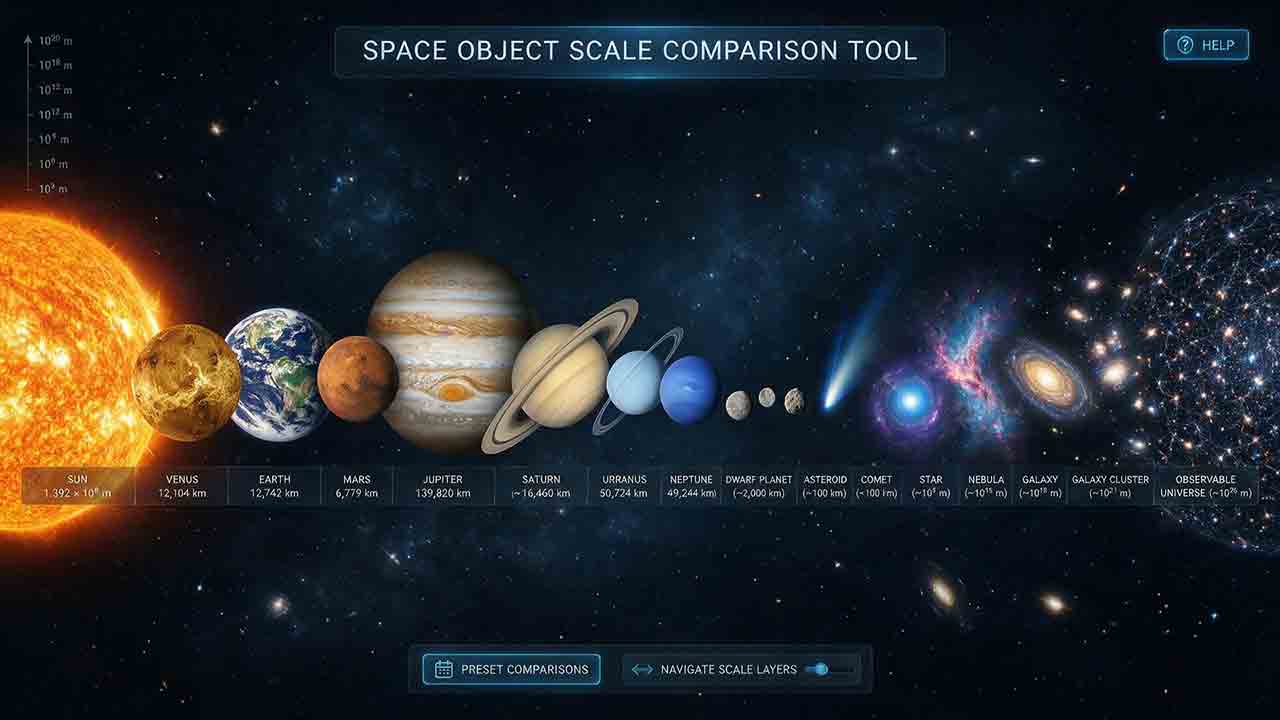
Space Object Scale Comparison Tool
This guide explains how to compare the physical sizes of Bennu, Ceres, Pluto, the Moon, the eight planets, and the Sun on one consistent linear scale. It defines the verified preset objects, distinguishes mean diameter from nominal or approximate width, and shows how to calculate diameter ratios, reference percentages, and scaled model sizes. Original value comes from the Definition–Ratio–Resolution Framework, the Scale-Span Problem, reversible ratio checks, and clear labels for reference-circle area and reference-sphere volume derivations. Worked examples include an Earth-at-10-centimeters model and the visibility limits created by the Sun-to-Bennu size span. The article also explains why rings, comet comae, exoplanets, diffuse nebulae, and black-hole boundaries require custom definitions rather than ordinary planet-diameter presets. Readers gain a practical method for building accurate classroom models, tables, and visualizations without mixing physical size, mass, orbital distance, or angular size.
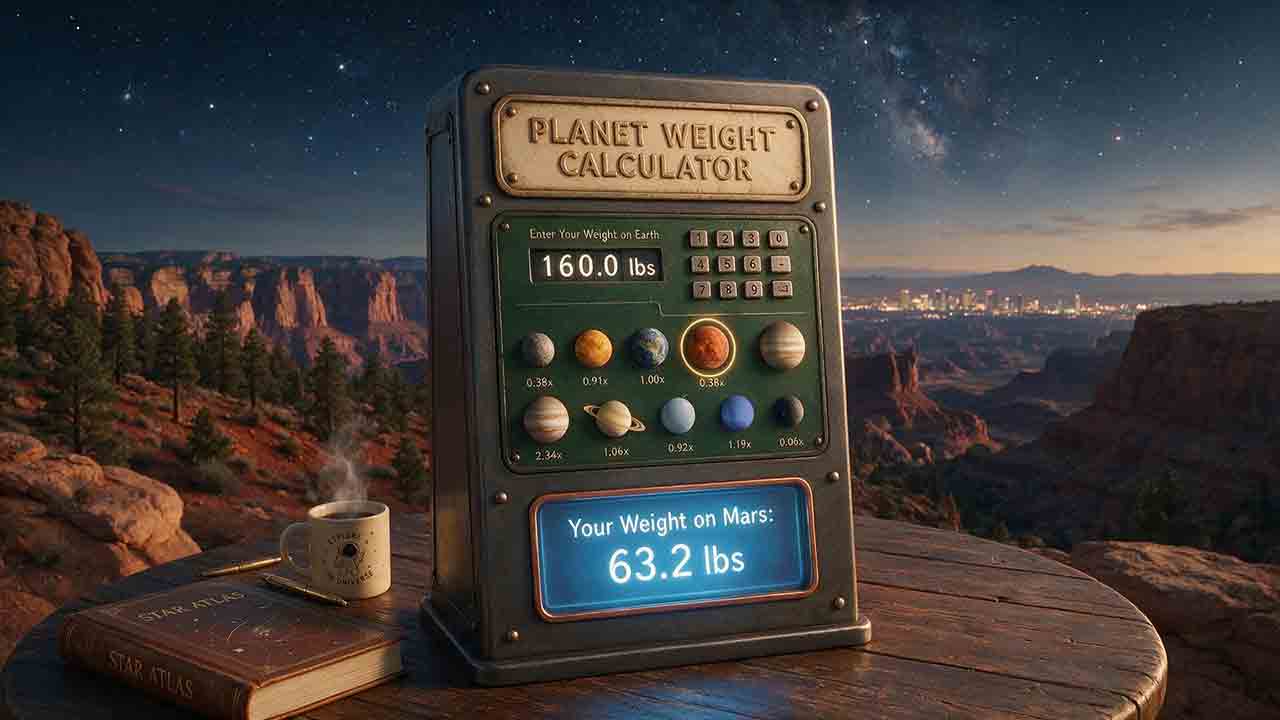
Planet Weight Calculator
This guide explains how a planet weight calculator separates unchanged mass from gravitational force and standard-Earth force equivalents. It shows how to calculate weight with W = mg, interpret kilograms, pound-mass, newtons, pound-force, kg-equivalent, and lb-equivalent, and understand why local scale readings depend on instrument calibration. Sourced gravity presets cover the eight planets, the Moon, and Pluto, with clear warnings for giant planets that have no solid surface. Worked examples, verification values, altitude limits, custom-planet formulas, uncertainty propagation, and the original Reference–Instrument–Support Check help readers evaluate results without confusing force, mass, apparent weight, or reference gravity. The article also explains free fall, reference radii, Pluto data differences, and when a body-specific gravity model is required.
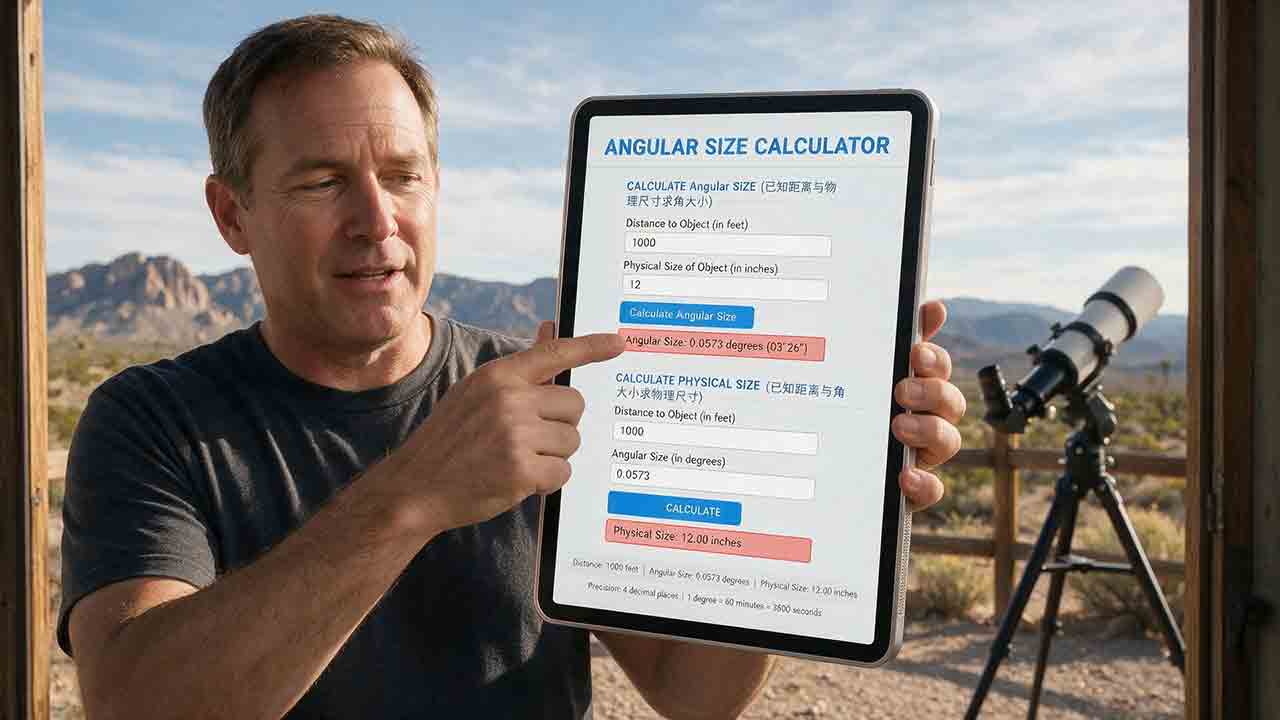
Angular Size Calculator
This guide explains how to calculate angular size, physical size, or distance using projected-width, spherical-limb, and small-angle geometry. It defines the correct distance for a flat projected width, distinguishes center distance for a spherical body, and shows when the small-angle approximation is accurate enough. Readers can verify calculator output with independent test values, a back-calculation check, worked Moon and deep-sky examples, and a reproducible approximation-error table. The article also covers radians, degrees, arcminutes, arcseconds, orientation, field of view, pixel coverage, uncertainty, catalog size differences, and angular-diameter distance in cosmology. Its Geometry–Quantity–Scale check and audit checklist help prevent radius-versus-diameter mistakes, mixed units, incorrect distance inputs, and confusion between angular size, resolution, and field of view.
Explore More Topics
Astrophotography Storage Calculator
This guide explains how to estimate storage for astrophotography capture, processing, and backup without relying on misleading megapixel shortcuts. It compares measured-file, uncompressed-array, and bitrate methods; distinguishes mean, median, high-percentile, and maximum file-size statistics; and explains decimal versus binary storage units. Readers learn how FITS headers, padding, HDUs, RAW compression, calibration frames, RGB conversion, drizzle, mosaics, caches, and temporary files affect project size. Original planning tools include the Four-Bucket Storage Ledger, the Capture–Process–Protect Check, and a clearly defined storage expansion ratio. Worked examples show how to calculate peak logical data, project-relative headroom, complete-copy footprint, media count, write rate, and transfer time. The article also covers integrity verification, backup limitations, retention decisions, and troubleshooting. It is designed to help astrophotographers build realistic capacity plans for single sessions, multi-night projects, planetary video, star trails, and long-term archives.
Star Trail Exposure Calculator
This guide explains how to calculate star-trail exposure time from Earth’s sidereal rotation, stellar declination, and local image scale. It distinguishes polar sweep, declination-adjusted sky-path length, projected pixel length, recorded sweep, missing sweep, and the full start-to-end span of a stacked sequence. Original tables compare trail lengths at several declinations, quantify one-second frame gaps at different image scales, and show how recorded time, gap time, duty cycle, and sequence sweep relate. The Trail–Frame–Sequence Check provides a practical framework for separating celestial geometry, per-frame reliability, and sequence continuity. Worked examples also address the celestial-pole edge case, local WCS-based pixel movement, frame-count limits, long-exposure noise reduction, and the difference between a single exposure and stacked frames. Readers can use the article to plan smoother trails, avoid misleading sequence calculations, and verify expected motion with native-resolution test images.
Camera Field of View Calculator
This guide explains how to calculate horizontal, vertical, and diagonal camera field of view from the recorded active sensor dimensions and effective focal length. It distinguishes physical focal length from crop-factor comparisons, shows why aspect ratio and target rotation affect framing, and provides independently calculated reference tables for common sensor sizes and focal lengths. The original Frame Envelope Check separates ideal frame geometry, the target envelope, and the usable frame retained after dithering, registration, distortion correction, and cropping. Worked examples demonstrate target occupancy, maximum permitted focal length, rotated bounding boxes, and mosaic panel counts with overlap. The article also explains radians versus degrees, crop and stabilization modes, focus breathing, rectilinear versus fisheye projection, and plate-solving verification through a celestial WCS. Readers can use the formulas, margin budget, troubleshooting table, and framing checklist to plan wide-field compositions, small-target imaging, or mosaics without treating a mathematical edge-to-edge fit as a guaranteed final frame.